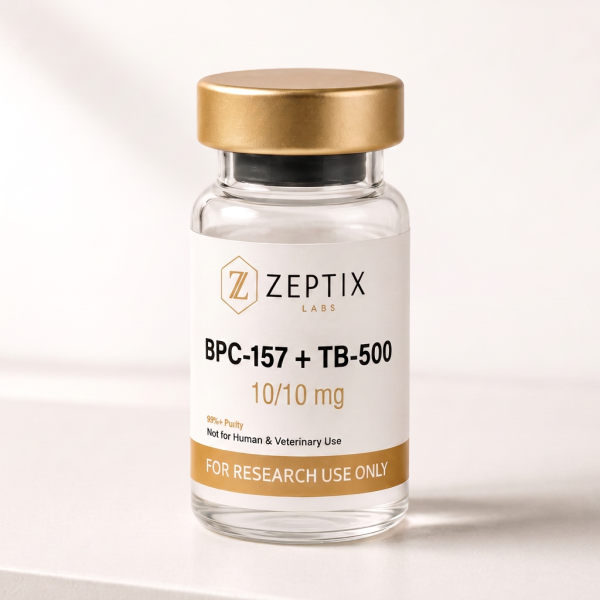

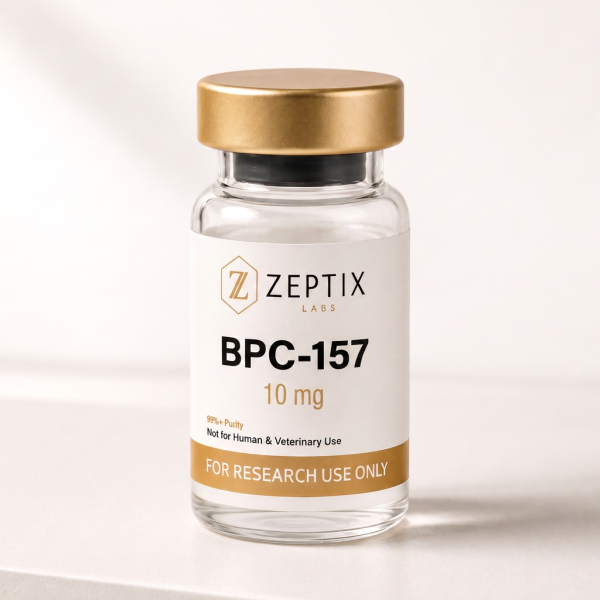
Disclaimer: Information is for research and educational purposes only. Catalog materials are not approved for human or veterinary use.
In catalog language, “benefits” usually means consumer outcomes. That is the wrong frame here. BPC-157 is a research peptide. The literature describes experimental readouts in cell systems and animal models, not approved effects in people.12
What experimental models actually report
Reviews and primary papers have discussed BPC-157 in gastrointestinal-injury models, tendon and muscle-healing assays, and nitric-oxide related signaling work. Those papers measure markers, histology, or functional scores in a defined protocol. They do not convert a lyophilized research vial into a medicine.135
- Tissue-response and remodeling markers in preclinical injury models.
- Gastric and intestinal barrier assays in rodents.
- Angiogenesis-related and nitric-oxide pathway observations in experimental systems.
How to read those papers in a lab
Match the sequence, the model, and the endpoint. A tendon-transection paper is not a protocol for a different tissue. A review is not a methods section. Confirm the lot in your vial against the COA before you treat any paper as a recipe.4
Zeptix Labs BPC-157 is for qualified laboratory research only. It is not intended to diagnose, treat, cure, or prevent any disease.
Research context and evidence base
BPC-157 literature spans synthetic-peptide characterization, gastrointestinal models, tendon and muscle assays, and proposed nitric-oxide or growth-factor signaling. Most findings come from cells or animals. A useful review therefore separates the measured endpoint from broader claims and records the exact sequence, model species, tissue, comparator, and observation period.12
How to interpret the published evidence
For this topic, the word “benefit” should be translated into a specific measured outcome. Cell-signaling changes, animal histology, pharmacokinetic movement, and validated clinical endpoints sit at different levels of evidence. They cannot be combined into one general promise. Read the population, model, control group, endpoint definition, and statistical limits before drawing a conclusion.3
Experimental design questions
For BPC-157 work, controls may need to separate vehicle effects, baseline injury response, sequence-specific activity, and assay drift. Histology, migration, tensile strength, inflammatory markers, and pathway readouts are different endpoints; selecting one after seeing the data increases bias. A protocol should also state whether it is testing a proposed mechanism or attempting to reproduce a previously published observation.
Building a reproducible laboratory record
For work involving BPC-157 Benefits, record the supplier, SKU, lot number, labeled amount, receipt date, storage history, reconstitution conditions, concentration calculation, control material, instrument or assay version, and prespecified endpoint. Keep the matching certificate of analysis with the run record. These details make a result auditable and help distinguish biological variation from a handling or identity problem.
- Match the exact compound, sequence, modification, and formulation to the cited methods.
- Use positive, negative, and vehicle controls appropriate to the assay.
- Define concentrations, time points, exclusions, and endpoints before reviewing results.
- Report null and unexpected findings alongside the planned readouts.
Quality, limitations, and research-use status
A certificate of analysis supports lot traceability but does not establish a biological outcome. Investigators remain responsible for method suitability, independent confirmation when required, and compliance with institutional rules. Zeptix Labs materials are supplied for qualified laboratory research only and are not drugs, supplements, cosmetics, foods, or materials for human or veterinary administration.
Reporting results without overreach
When reporting BPC-157 Benefits, state what the experiment directly measured and keep interpretation within that boundary. Include model limitations, uncertainty, failed quality controls, and alternative explanations. Avoid turning preclinical observations into treatment language or assuming that a statistically significant marker change is biologically important. Clear limitations make the article more useful to researchers and prevent laboratory evidence from being mistaken for consumer guidance.
References
- Kowalski, Ł., et al. “Multifunctionality and Possible Medical Application of the BPC 157 Peptide: Literature and Patent Review.” Pharmaceuticals 18, no. 2 (2025): 185. https://doi.org/10.3390/ph18020185
- Sikiric, P., et al. “Stable Gastric Pentadecapeptide BPC 157–NO-System Relation.” Current Pharmaceutical Design 20, no. 7 (2014): 1126–35. PMID 23755725. https://pubmed.ncbi.nlm.nih.gov/23755725/
- Chang, C. H., et al. “Oral Stable Gastric Pentadecapeptide BPC 157 Therapy in Muscle and Tendon Healing.” Pharmacological Reports 72, no. 1 (2020): 206–12. https://pubmed.ncbi.nlm.nih.gov/?term=Chang+BPC+157+Pharmacological+Reports+2020
- Sikiric, P., et al. “A New Gastric Juice Peptide, BPC. An Overview of the Stomach-Stress-Organoprotection Hypothesis and Beneficial Effects of BPC.” Journal of Physiology-Paris 87, no. 5 (1993): 313–27. PMID 8298609. https://pubmed.ncbi.nlm.nih.gov/8298609/
- Staresinic, M., et al. “Gastric Pentadecapeptide BPC 157 Accelerates Healing of Transected Rat Achilles Tendon and In Vitro Stimulates Tendocyte Growth.” Journal of Orthopaedic Research 21, no. 6 (2003): 976–83. PMID 14554208. https://pubmed.ncbi.nlm.nih.gov/14554208/
- Chang C-H, Kowalska A, Seiwerth S, et al. Oral stable gastric pentadecapeptide BPC 157 therapy in muscle and tendon healing. Pharmacological Reports . 2020;72(1):206–212. https://doi.org/10.1007/s43440-019-00004-4 https://pmc.ncbi.nlm.nih.gov/articles/PMC8275860/
- Sikiric P, Vukojevic J, Dominko K, et al. Brain–gut axis and pentadecapeptide BPC 157: theoretical and practical implications. Current Neuropharmacology . 2016;14(2):153–161. https://pubmed.ncbi.nlm.nih.gov/26471976/ https://pubmed.ncbi.nlm.nih.gov/27138887/
- Sikiric P, Seiwerth S, Gojkovic S, et al. Cytoprotective gastric pentadecapeptide BPC 157 resolves major vessel occlusion disturbances and ischemia–reperfusion injury. World Journal of Gastroenterology . 2022;28(1):23–46. https://doi.org/10.3748/wjg.v28.i1.23 https://pubmed.ncbi.nlm.nih.gov/35125818/
- Starešinić M, Sebečić B, Patrlj L, et al. Gastric pentadecapeptide BPC 157 accelerates healing of transected rat Achilles tendon and in vitro stimulates tendocyte growth. J Orthop Res. 2003;21(6):976–983. https://doi.org/10.1016/S0736-0266(03)00110-4
- Sikirić P, Petek M, Rućman R, Seiwerth S, et al. A new gastric juice peptide, BPC. An overview of the stomach-stress-organoprotection hypothesis and beneficial effects of BPC. J Physiol Paris. 1993;87(5):313–327. https://doi.org/10.1016/0928-4257(93)90038-U