
Disclaimer: Information is for research and educational purposes only. Catalog materials are not approved for human or veterinary use.
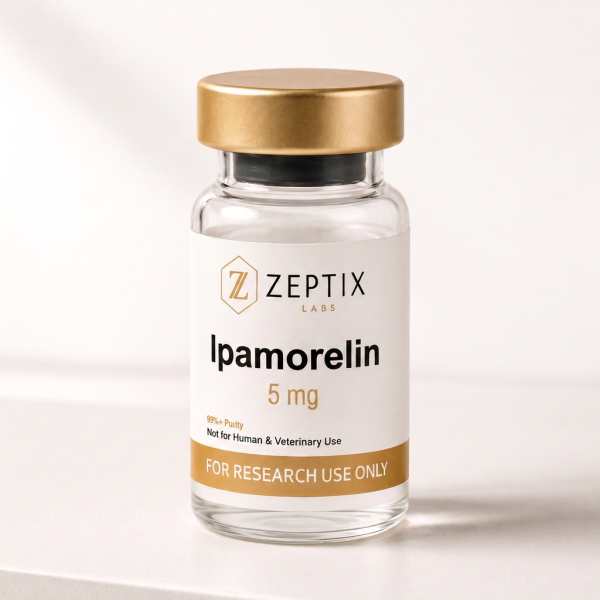
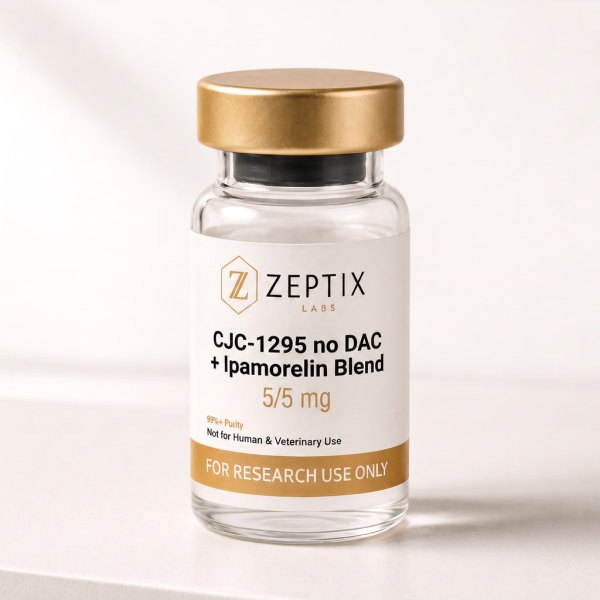
CJC-1295 is a synthetic GHRH analog. “No DAC” means the Drug Affinity Complex is absent, so the analog is studied as a shorter-acting GHRH-receptor ligand compared with DAC-bearing versions discussed in the literature. Ipamorelin acts at the ghrelin receptor. The Zeptix blend puts both into one research-use vial.
Two receptors, one mixture
GHRH-receptor and GHS-R ligands are often compared because both can sit on the growth-hormone axis in an intact system. Pairing them is a design choice. It is useful when the question is about the combination. It is a confound when the question is about one receptor.
DAC versus no DAC, briefly
DAC chemistry is a half-life and binding story in published analog work. The Zeptix catalog item is the no-DAC blend. Do not cite DAC-CJC papers as if they describe this SKU. Match the analog form to the methods you are reproducing.
Tesamorelin is a different analog
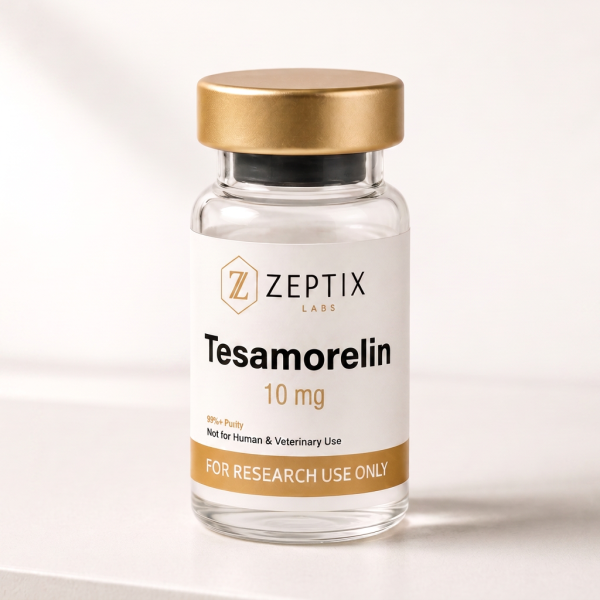
Tesamorelin is also a GHRH analog, sold here as its own research peptide. It is not a drop-in replacement for CJC-1295 no DAC. Sequence, modifications, and literature are different.
The blend is for laboratory research only. Not for ingestion, injection as a consumer product, compounding, or veterinary application.
Research context and evidence base
CJC-1295 is a GHRH analog family in which DAC status materially changes the experimental object. DAC-bearing and no-DAC forms differ in binding and exposure assumptions, while a product blended with ipamorelin introduces a second receptor ligand. Literature review and inventory records should identify the exact form rather than relying on the shortened catalog name.12
How to interpret the published evidence
Evidence should be sorted by study type before it is summarized. Analytical characterization establishes what material was tested; cell work can suggest pathways; animal models can explore integrated biology; and human studies, when they exist, apply only to their regulated product, population, and design. One layer should not be presented as if it proves the next.3
Experimental design questions
CJC-1295 design begins by naming DAC status and whether ipamorelin is present. Suitable controls may include vehicle, the exact CJC form alone, ipamorelin alone, and the blend. Exposure windows and sampling schedules derived from DAC-bearing analogs should not be transferred to no-DAC material without validation.
Building a reproducible laboratory record
For work involving CJC-1295 no DAC and Ipamorelin, record the supplier, SKU, lot number, labeled amount, receipt date, storage history, reconstitution conditions, concentration calculation, control material, instrument or assay version, and prespecified endpoint. Keep the matching certificate of analysis with the run record. These details make a result auditable and help distinguish biological variation from a handling or identity problem.
- Match the exact compound, sequence, modification, and formulation to the cited methods.
- Use positive, negative, and vehicle controls appropriate to the assay.
- Define concentrations, time points, exclusions, and endpoints before reviewing results.
- Report null and unexpected findings alongside the planned readouts.
Quality, limitations, and research-use status
A certificate of analysis supports lot traceability but does not establish a biological outcome. Investigators remain responsible for method suitability, independent confirmation when required, and compliance with institutional rules. Zeptix Labs materials are supplied for qualified laboratory research only and are not drugs, supplements, cosmetics, foods, or materials for human or veterinary administration.
Reporting results without overreach
When reporting CJC-1295 no DAC and Ipamorelin, state what the experiment directly measured and keep interpretation within that boundary. Include model limitations, uncertainty, failed quality controls, and alternative explanations. Avoid turning preclinical observations into treatment language or assuming that a statistically significant marker change is biologically important. Clear limitations make the article more useful to researchers and prevent laboratory evidence from being mistaken for consumer guidance.
References
- Rivier J, Spiess J, Thorner MO, Vale W. Characterization of a growth hormone-releasing factor from a human pancreatic islet tumour. Nature. 1982;300(5889):276–278. https://pubmed.ncbi.nlm.nih.gov/6292724/
- Guillemin R, Brazeau P, Bohlen P, et al. Growth hormone-releasing factor from a human pancreatic tumor that caused acromegaly. Science. 1982;218(4572):585–587. https://pubmed.ncbi.nlm.nih.gov/6812220/
- Losa M, Schopohl J, von Werder K. Stimulation of GH with human GRF1-44, GRF1-40, and GRF1-29 in normal subjects. Klin Wochenschr. 1984;62(23):1109–1113. https://pubmed.ncbi.nlm.nih.gov/6240568/
- Svensson J, Bengtsson BA, et al. Ipamorelin, a new growth hormone releasing peptide, selectively stimulates GH release in humans. J Clin Endocrinol Metab. 1998;83(2): 2509–2515. https://pubmed.ncbi.nlm.nih.gov/9709924/
- Raun K, Hansen BS, Johansen NL, et al. Ipamorelin, a novel pentapeptide growth hormone secretagogue. Eur J Endocrinol. 1998;139(5):552–561. https://pubmed.ncbi.nlm.nih.gov/9849815/
- Walker RF, Codd EE, Walker RM. Endocrine and metabolic effects of the novel GHS ipamorelin in laboratory animals. Growth Horm IGF Res. 1999;9(4):352–360. https://pubmed.ncbi.nlm.nih.gov/10611799/