
Disclaimer: Information is for research and educational purposes only. Catalog materials are not approved for human or veterinary use.
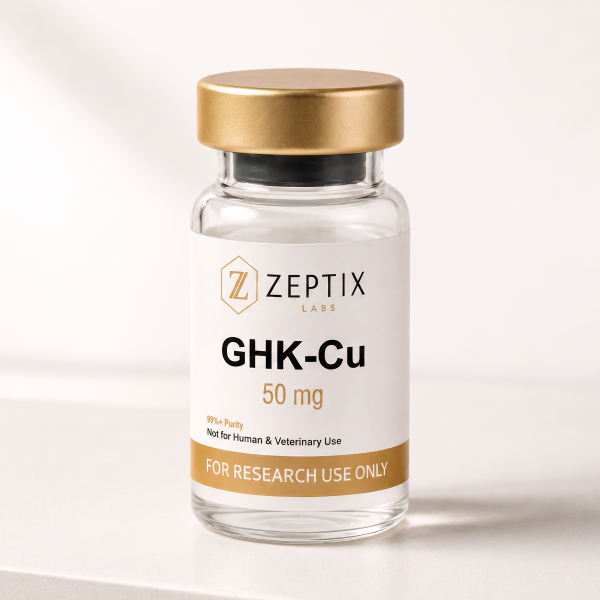
GHK binds Cu(II) tightly. Most mechanism write-ups treat the complex, not the free tripeptide, as the species of interest. That is why identity work should confirm the complex, not only a peptide peak.13
What labs usually vary
Copper concentration, pH, and competing ligands change the experiment. Gene-expression papers are a different design from a simple binding assay. Pick the paper that matches the question.2
For qualified laboratory research only.
Research context and evidence base
GHK-Cu research depends on both the peptide and its copper complex. Buffer composition, pH, competing ligands, copper availability, and oxidation conditions can all change what an assay measures. Matrix-related or gene-expression findings should be read as model-specific observations, not as finished-product cosmetic claims.12
How to interpret the published evidence
Mechanism claims are strongest when a study connects target engagement to a downstream change and tests that connection with an appropriate control or inhibitor. Binding alone does not prove every later effect, and a downstream marker does not identify the only pathway involved. Treat diagrams as hypotheses unless each step was measured in the model under discussion.3
Experimental design questions
GHK-Cu experiments should control for free copper, GHK without copper where appropriate, the buffer, and any competing chelator. Colorimetric, gene-expression, matrix, and viability assays can each respond to copper chemistry differently. Measuring a matrix marker without checking viability or copper availability can create an attractive but incomplete result.
Building a reproducible laboratory record
For work involving How Does GHK-Cu Work, record the supplier, SKU, lot number, labeled amount, receipt date, storage history, reconstitution conditions, concentration calculation, control material, instrument or assay version, and prespecified endpoint. Keep the matching certificate of analysis with the run record. These details make a result auditable and help distinguish biological variation from a handling or identity problem.
- Match the exact compound, sequence, modification, and formulation to the cited methods.
- Use positive, negative, and vehicle controls appropriate to the assay.
- Define concentrations, time points, exclusions, and endpoints before reviewing results.
- Report null and unexpected findings alongside the planned readouts.
Quality, limitations, and research-use status
A certificate of analysis supports lot traceability but does not establish a biological outcome. Investigators remain responsible for method suitability, independent confirmation when required, and compliance with institutional rules. Zeptix Labs materials are supplied for qualified laboratory research only and are not drugs, supplements, cosmetics, foods, or materials for human or veterinary administration.
Reporting results without overreach
When reporting How Does GHK-Cu Work, state what the experiment directly measured and keep interpretation within that boundary. Include model limitations, uncertainty, failed quality controls, and alternative explanations. Avoid turning preclinical observations into treatment language or assuming that a statistically significant marker change is biologically important. Clear limitations make the article more useful to researchers and prevent laboratory evidence from being mistaken for consumer guidance.
References
- Pickart, L., and Margolina, A. “Regenerative and Protective Actions of the GHK-Cu Peptide in the Light of the New Gene Data.” International Journal of Molecular Sciences 19, no. 7 (2018): 1987. https://doi.org/10.3390/ijms19071987
- Pickart, L. “The Human Tri-Peptide GHK and Tissue Remodeling.” Journal of Biomaterials Science, Polymer Edition 19, no. 8 (2008): 969–88. https://pubmed.ncbi.nlm.nih.gov/18644225/
- Pickart, L., Vasquez-Soltero, J. M., and Margolina, A. “GHK Peptide as a Natural Modulator of Multiple Cellular Pathways in Skin Regeneration.” BioMed Research International 2015: 648108. https://pubmed.ncbi.nlm.nih.gov/26236730/
- Pickart L, Margolina A. The human tri-peptide GHK and tissue remodeling. J Biomater Sci Polym Ed. 2008;19(8):969–988. https://pubmed.ncbi.nlm.nih.gov/18644225/
- Pickart L, Vasquez-Soltero JM, Margolina A. GHK-Cu may prevent oxidative stress in skin by regulating copper and modifying expression of antioxidant genes. Cosmetics. 2015;2(3):236–247. https://doi.org/10.3390/cosmetics2030236
- Pickart L, Margolina A. Regenerative and protective actions of the GHK-Cu peptide in the light of the new gene data. Int J Mol Sci. 2018;19(7):1987. https://pubmed.ncbi.nlm.nih.gov/29958416/
- Farris PK. Cosmeceuticals and Cosmetic Practice. 2nd ed. Wiley-Blackwell; 2014. https://www.wiley.com/en-us/Cosmeceuticals+and+Cosmetic+Practice-p-9780470654550
- Jose S, Hughbanks ML, Binder BY, Ingavle GC, Leach JK. Enhanced trophic factor secretion by mesenchymal stem/stromal cells with Glycine-Histidine-Lysine peptide and copper. Int J Mol Sci. 2020;21(17):6235. https://pubmed.ncbi.nlm.nih.gov/32847123/
- Kowalski, Ł., et al. “Multifunctionality and Possible Medical Application of the BPC 157 Peptide: Literature and Patent Review.” Pharmaceuticals 18, no. 2 (2025): 185. https://doi.org/10.3390/ph18020185
- Starešinić M, Sebečić B, Patrlj L, et al. Gastric pentadecapeptide BPC 157 accelerates healing of transected rat Achilles tendon and in vitro stimulates tendocyte growth. J Orthop Res. 2003;21(6):976–983. https://doi.org/10.1016/S0736-0266(03)00110-4