
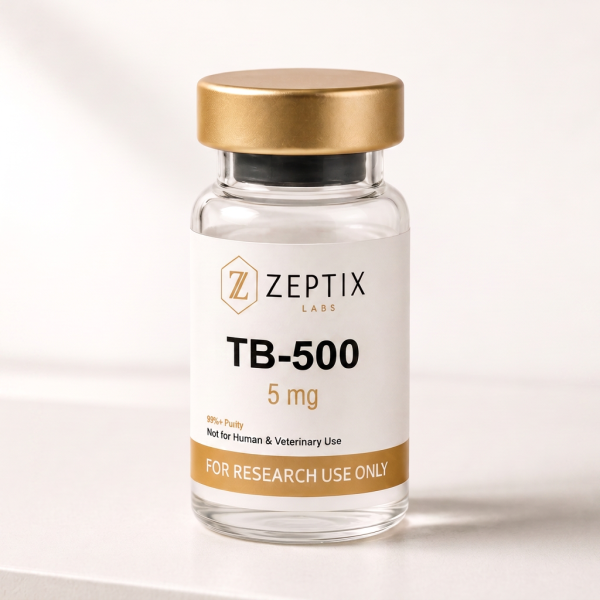
Disclaimer: Information is for research and educational purposes only. Catalog materials are not approved for human or veterinary use.
A mechanism of action, in research writing, is a proposed chain of events. For TB-500 that chain is usually told through thymosin beta-4: the peptide binds G-actin, changes the monomer–polymer balance, and that shift shows up in migration and cytoskeletal assays.12
What a protocol can test
Typical questions are comparative. Does identity-confirmed material change a migration score versus control? Does an actin-directed inhibitor flatten the result? Those questions belong in a notebook, not in a product story.3
Mechanism language is not a use instruction. Research use only.
Research context and evidence base
TB-500 discussions frequently draw from thymosin beta-4 research on actin sequestration, cell migration, angiogenesis, and tissue remodeling. The catalog name and the molecule described in a paper are not automatically interchangeable. Researchers should verify the sequence or fragment, assay system, and identity data before treating a publication as applicable to a specific vial.12
How to interpret the published evidence
Mechanism claims are strongest when a study connects target engagement to a downstream change and tests that connection with an appropriate control or inhibitor. Binding alone does not prove every later effect, and a downstream marker does not identify the only pathway involved. Treat diagrams as hypotheses unless each step was measured in the model under discussion.3
Experimental design questions
In TB-500 or thymosin beta-4 models, verify whether the paper used the full sequence, a fragment, or an endogenous protein preparation. Migration assays need consistent confluence and imaging intervals, while actin-related work needs an appropriate cytoskeletal readout. A BPC-157 comparison or multi-peptide blend requires additional single-compound controls if attribution to one component matters.
Building a reproducible laboratory record
For work involving How Does TB-500 Work, record the supplier, SKU, lot number, labeled amount, receipt date, storage history, reconstitution conditions, concentration calculation, control material, instrument or assay version, and prespecified endpoint. Keep the matching certificate of analysis with the run record. These details make a result auditable and help distinguish biological variation from a handling or identity problem.
- Match the exact compound, sequence, modification, and formulation to the cited methods.
- Use positive, negative, and vehicle controls appropriate to the assay.
- Define concentrations, time points, exclusions, and endpoints before reviewing results.
- Report null and unexpected findings alongside the planned readouts.
Quality, limitations, and research-use status
A certificate of analysis supports lot traceability but does not establish a biological outcome. Investigators remain responsible for method suitability, independent confirmation when required, and compliance with institutional rules. Zeptix Labs materials are supplied for qualified laboratory research only and are not drugs, supplements, cosmetics, foods, or materials for human or veterinary administration.
Reporting results without overreach
When reporting How Does TB-500 Work, state what the experiment directly measured and keep interpretation within that boundary. Include model limitations, uncertainty, failed quality controls, and alternative explanations. Avoid turning preclinical observations into treatment language or assuming that a statistically significant marker change is biologically important. Clear limitations make the article more useful to researchers and prevent laboratory evidence from being mistaken for consumer guidance.
References
- Goldstein, A. L., Hannappel, E., and Kleinman, H. K. “Thymosin β4: Actin-Sequestering Protein Moonlights to Repair Injured Tissues.” Trends in Molecular Medicine 11, no. 9 (2005): 421–29. https://pubmed.ncbi.nlm.nih.gov/16099219/
- Malinda, K. M., et al. “Thymosin β4 Accelerates Wound Healing.” Journal of Investigative Dermatology 113, no. 3 (1999): 364–68. https://pubmed.ncbi.nlm.nih.gov/10469335/
- Philp, D., Goldstein, A. L., and Kleinman, H. K. “Thymosin β4 Promotes Angiogenesis, Wound Healing, and Hair Follicle Development.” Mechanisms of Ageing and Development 125, no. 2 (2004): 113–15. https://pubmed.ncbi.nlm.nih.gov/15037013/
- Cassimeris L, Safer D, Nachmias VT, Zigmond SH. Thymosin β4 sequesters the majority of G-actin in resting human polymorphonuclear leukocytes. J Cell Biol. 1992;119(5):1261–1270. https://doi.org/10.1083/jcb.119.5.1261 https://doi.org/10.3390/ph18020185
- Sosne G, Wheeler LA, Zijah SS, et al. Thymosin β4: a novel corneal wound-healing and anti-inflammatory agent. Ann N Y Acad Sci. 2007;1112:232–240. https://pubmed.ncbi.nlm.nih.gov/17947584/ https://pubmed.ncbi.nlm.nih.gov/23755725/
- Smartt JM, Watkins SC, Zaidi HA, et al. A Phase 2 trial of topical Thymosin β4 (RGN-137) for chronic pressure and venous stasis ulcers. Wound Repair Regen. 2007;15(4):544–552. https://pubmed.ncbi.nlm.nih.gov/17650097/
- Ti D, Hao H, Fu X, et al. Thymosin β4 promotes tendon healing by improving collagen organization and mechanical strength. J Orthop Res. 2010;28(5):673–681. https://pubmed.ncbi.nlm.nih.gov/19902491/ https://pubmed.ncbi.nlm.nih.gov/8298609/
- Bock-Marquette I, Saxena A, White MD, et al. Thymosin β4 activates integrin-linked kinase and promotes cardiac cell migration, survival, and repair. J Biol Chem. 2010;285(51):39345–39354. https://pubmed.ncbi.nlm.nih.gov/20691219/
- Stewart DJ, Wei CC, Pabon M, et al. Thymosin β4 confers long-term survival benefit in a murine model of acute myocardial infarction. Circ Res. 2012;111(7):940–950. https://doi.org/10.1161/CIRCRESAHA.112.268680
- Fan J, Xu G, Jiang T, et al. Anti-fibrotic and anti-inflammatory effects of Thymosin β4 in organ injury models. Front Endocrinol (Lausanne). 2021;12:767785. https://www.frontiersin.org/articles/10.3389/fendo.2021.767785/full