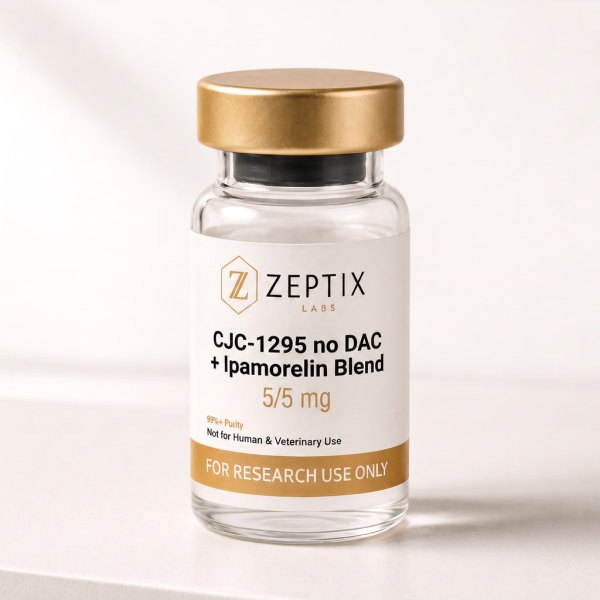

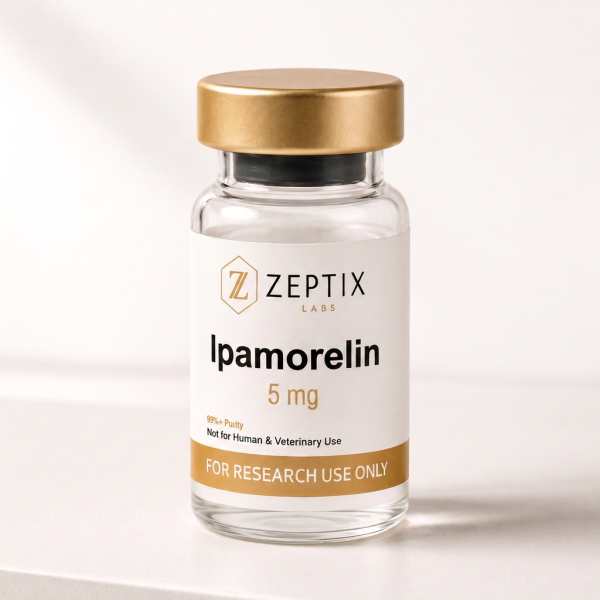
Disclaimer: Information is for research and educational purposes only. Catalog materials are not approved for human or veterinary use.
Ipamorelin is used as a selective GHS-R1a agonist in secretagogue research. Papers compare it with older ligands that hit more hormone axes. Selectivity is a pharmacology result, not a wellness claim.12
Ipamorelin is for qualified laboratory research only.
Research context and evidence base
Ipamorelin appears in ghrelin-receptor and growth-hormone-secretagogue research. Its selectivity is normally established against named receptors, hormones, and comparator ligands under defined conditions. Results from an intact endocrine model cannot be assumed in a receptor-only assay, and findings for a single peptide do not automatically describe a CJC-1295 and ipamorelin blend.12
How to interpret the published evidence
For this topic, the word “benefit” should be translated into a specific measured outcome. Cell-signaling changes, animal histology, pharmacokinetic movement, and validated clinical endpoints sit at different levels of evidence. They cannot be combined into one general promise. Read the population, model, control group, endpoint definition, and statistical limits before drawing a conclusion.3
Experimental design questions
Ipamorelin studies should name the receptor system, comparator secretagogue, and downstream hormone or signaling assay. In combination work, single-agent arms help distinguish additive, synergistic, and independent responses. Endocrine-axis readouts also require a model with the relevant tissues and feedback loops; a receptor assay cannot reproduce an intact physiological axis.
Building a reproducible laboratory record
For work involving Ipamorelin Benefits, record the supplier, SKU, lot number, labeled amount, receipt date, storage history, reconstitution conditions, concentration calculation, control material, instrument or assay version, and prespecified endpoint. Keep the matching certificate of analysis with the run record. These details make a result auditable and help distinguish biological variation from a handling or identity problem.
- Match the exact compound, sequence, modification, and formulation to the cited methods.
- Use positive, negative, and vehicle controls appropriate to the assay.
- Define concentrations, time points, exclusions, and endpoints before reviewing results.
- Report null and unexpected findings alongside the planned readouts.
Quality, limitations, and research-use status
A certificate of analysis supports lot traceability but does not establish a biological outcome. Investigators remain responsible for method suitability, independent confirmation when required, and compliance with institutional rules. Zeptix Labs materials are supplied for qualified laboratory research only and are not drugs, supplements, cosmetics, foods, or materials for human or veterinary administration.
Reporting results without overreach
When reporting Ipamorelin Benefits, state what the experiment directly measured and keep interpretation within that boundary. Include model limitations, uncertainty, failed quality controls, and alternative explanations. Avoid turning preclinical observations into treatment language or assuming that a statistically significant marker change is biologically important. Clear limitations make the article more useful to researchers and prevent laboratory evidence from being mistaken for consumer guidance.
References
- Raun, K., et al. “Ipamorelin, the First Selective Growth Hormone Secretagogue.” European Journal of Endocrinology 139, no. 5 (1998): 552–61. https://pubmed.ncbi.nlm.nih.gov/9849822/
- Johansen, P. B., et al. “Ipamorelin, a New Growth-Hormone-Releasing Peptide, Induces Longitudinal Bone Growth in Rats.” Growth Hormone & IGF Research 9, no. 2 (1999): 106–13. https://pubmed.ncbi.nlm.nih.gov/10373343/
- Gobburu, J. V., et al. “Pharmacokinetic-Pharmacodynamic Modeling of Ipamorelin, a Growth Hormone Releasing Peptide, in Human Volunteers.” Pharmaceutical Research 16, no. 9 (1999): 1412–16. https://pubmed.ncbi.nlm.nih.gov/10496658/
- Svensson J, Bengtsson BA, et al. Ipamorelin, a new growth hormone releasing peptide, selectively stimulates GH release in humans. J Clin Endocrinol Metab. 1998;83(2): 2509–2515. https://pubmed.ncbi.nlm.nih.gov/9709924/
- Raun K, Hansen BS, Johansen NL, et al. Ipamorelin, a novel pentapeptide growth hormone secretagogue. Eur J Endocrinol. 1998;139(5):552–561. https://pubmed.ncbi.nlm.nih.gov/9849815/
- Walker RF, Codd EE, Walker RM. Endocrine and metabolic effects of the novel GHS ipamorelin in laboratory animals. Growth Horm IGF Res. 1999;9(4):352–360. https://pubmed.ncbi.nlm.nih.gov/10611799/
- Schopohl J, Strasburger CJ, et al. Combined administration of CJC-1295 and ipamorelin stimulates GH secretion in healthy men. Growth Horm IGF Res. 2011;21(1): 31–38. https://pubmed.ncbi.nlm.nih.gov/21093273/
- Teichman SL, Neale A, Lawrence B, Gagnon C, Castaigne JP, Frohman LA. Prolonged stimulation of growth hormone and insulin-like growth factor I secretion by CJC-1295, a long-acting analog of GH-releasing hormone, in healthy adults. J Clin Endocrinol Metab. 2006;91(3):799–805. https://pubmed.ncbi.nlm.nih.gov/16352683/ https://pubmed.ncbi.nlm.nih.gov/16352683/?utm_source=chatgpt.com
- Ionescu M, Frohman LA. Pulsatile secretion of growth hormone persists during continuous stimulation by CJC-1295, a long-acting growth hormone-releasing hormone analog. J Clin Endocrinol Metab. 2006;91(12):4792–4797. https://pubmed.ncbi.nlm.nih.gov/17018654/ https://pubmed.ncbi.nlm.nih.gov/17018654/?utm_source=chatgpt.com
- Prakash A, Goa KL. Sermorelin: a review of its use in the diagnosis and treatment of children with idiopathic growth hormone deficiency. BioDrugs. 1999;12(6):419–436. https://pubmed.ncbi.nlm.nih.gov/18031173/ https://pubmed.ncbi.nlm.nih.gov/18031173/?utm_source=chatgpt.com