
Disclaimer: Information is for research and educational purposes only. Catalog materials are not approved for human or veterinary use.
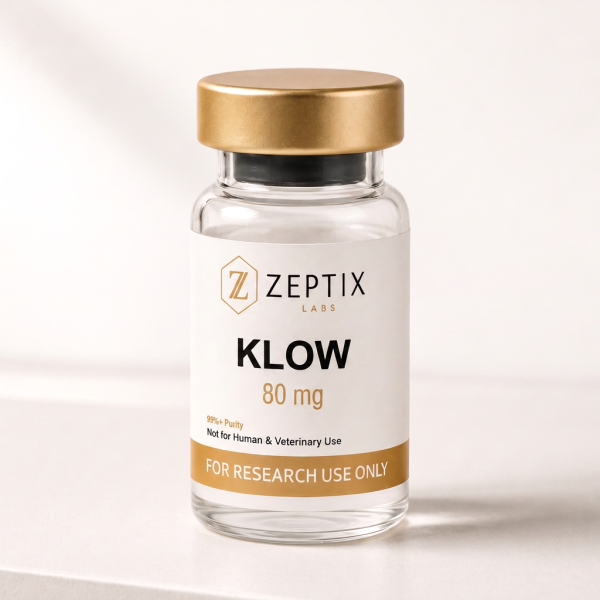
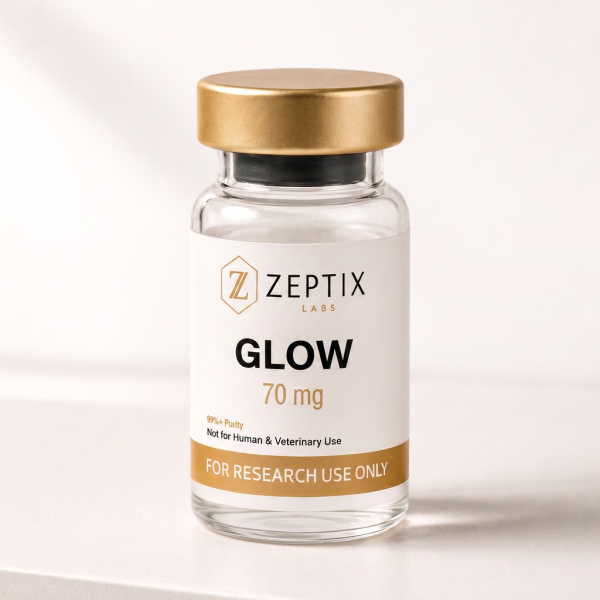
KLOW and GLOW are two Zeptix Labs research blends that are easy to confuse because they share most of their contents. GLOW combines three peptides: GHK-Cu, BPC-157 and TB-500. KLOW contains the same three plus KPV. Neither is a stronger or weaker version of the other. They are two different reagents, and the right one depends on whether KPV belongs in the experiment.
What is in each blend
| Component | GLOW | KLOW | What it is |
|---|---|---|---|
| GHK-Cu | Yes | Yes | Copper complex of the tripeptide Gly-His-Lys |
| BPC-157 | Yes | Yes | Synthetic 15-amino-acid peptide |
| TB-500 | Yes | Yes | Peptide related to thymosin beta-4 |
| KPV | No | Yes | Tripeptide Lys-Pro-Val from alpha-MSH |
The vial sizes differ too: GLOW is listed at 70 mg and KLOW at 80 mg of total peptide. Always work from the lot's certificate of analysis for what a specific vial contains.
What KPV is
KPV is the tripeptide lysine-proline-valine, the last three amino acids (positions 11 to 13) of alpha-melanocyte-stimulating hormone (alpha-MSH). It is studied as a small fragment in inflammatory-signaling models rather than as a full melanocortin hormone.1 In intestinal epithelial cell models it is taken up by the peptide transporter PepT1, which is one reason it appears so often in gut-barrier and epithelial research.2
That is the experimental difference between the blends. Adding KPV brings an inflammatory-signaling and epithelial-barrier component into a mixture that otherwise centers on copper-peptide, tissue-response and actin-related research.
What the shared three bring
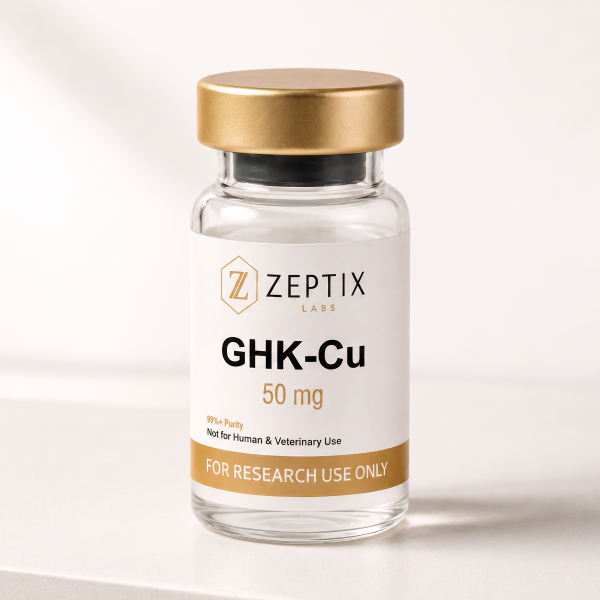
- GHK-Cu is a copper-binding tripeptide studied in extracellular-matrix and gene-expression models. Its copper chemistry matters: the complex gives solutions a faint blue color, and chelators such as EDTA in a buffer will pull the copper away.3
- BPC-157 is a synthetic pentadecapeptide studied mostly in animal tissue-response and gastric models.4
- TB-500 is the market name for a peptide related to thymosin beta-4, a G-actin binding protein studied in cell-migration and wound models.5
Which blend fits a protocol
- KPV is part of the hypothesis: use KLOW.
- The protocol names only GHK-Cu, BPC-157 and TB-500: use GLOW. KLOW would add an uncontrolled variable.
- The question is what KPV adds: run GLOW and KLOW side by side. The difference points to KPV, provided both lots are documented and handled the same way.
- The question is which component drives a result: neither blend can answer that. Run the single peptides (GHK-Cu, BPC-157 and TB-500 are all listed on their own) alongside the blend.
Handling notes
Both blends arrive lyophilized and are reconstituted the same way. Because both contain GHK-Cu, avoid buffers with strong copper chelators unless removing copper is the point, and use a vehicle control made with the same diluent. Record the blend's lot number and COA with each run, since a blend's composition is defined per lot.
KLOW and GLOW are research blends for laboratory use only. They are not cosmetics, drugs or compounded preparations, and are not for human or veterinary use.
Frequently asked questions
What is the difference between KLOW and GLOW?
Both contain GHK-Cu, BPC-157 and TB-500. KLOW also contains KPV, a tripeptide from alpha-MSH studied in inflammatory-signaling models.
Is KLOW stronger than GLOW?
That is not a meaningful comparison. KLOW is a different composition, not a higher dose of GLOW. Choose by whether KPV belongs in the experiment.
Does GLOW contain KPV?
No. GLOW contains GHK-Cu, BPC-157 and TB-500 only.
References
- Brzoska T, Luger TA, Maaser C, Abels C, Böhm M. Alpha-melanocyte-stimulating hormone and related tripeptides: biochemistry, antiinflammatory and protective effects in vitro and in vivo, and future perspectives for the treatment of immune-mediated inflammatory diseases. Endocr Rev. 2008;29(5):581-602. https://doi.org/10.1210/er.2007-0027
- Dalmasso G, Charrier-Hisamuddin L, Nguyen HTT, et al. PepT1-mediated tripeptide KPV uptake reduces intestinal inflammation. Gastroenterology. 2008;134(1):166-178. https://doi.org/10.1053/j.gastro.2007.10.026
- Pickart L, Margolina A. Regenerative and protective actions of the GHK-Cu peptide in the light of the new gene data. Int J Mol Sci. 2018;19(7):1987. https://doi.org/10.3390/ijms19071987
- Staresinic M, Sebecic B, Patrlj L, et al. Gastric pentadecapeptide BPC 157 accelerates healing of transected rat Achilles tendon and in vitro stimulates tendocytes growth. J Orthop Res. 2003;21(6):976-983. https://pubmed.ncbi.nlm.nih.gov/14554208/
- Goldstein AL, Hannappel E, Sosne G, Kleinman HK. Thymosin β4: a multi-functional regenerative peptide. Basic properties and clinical applications. Expert Opin Biol Ther. 2012;12(1):37-51. https://doi.org/10.1517/14712598.2012.634793