
Disclaimer: Information is for research and educational purposes only. Catalog materials are not approved for human or veterinary use.
Tesamorelin is studied as a stabilized GHRH analog. Clinical literature exists for a specific approved drug product in a narrow indication. That file is not what a research catalog sells, and it is not a benefit list for a laboratory vial.12
What analog research is usually measuring
- GHRH-receptor engagement and pituitary-axis markers in experimental systems.
- Downstream IGF-1 related signaling in models that have an intact axis.
- Metabolic and adipose-marker panels in published clinical or translational papers that used the approved product, which is not interchangeable with research-grade powder.
Keep the approved drug and the research reagent in separate mental bins. Cite the paper that matches the material you actually hold.3
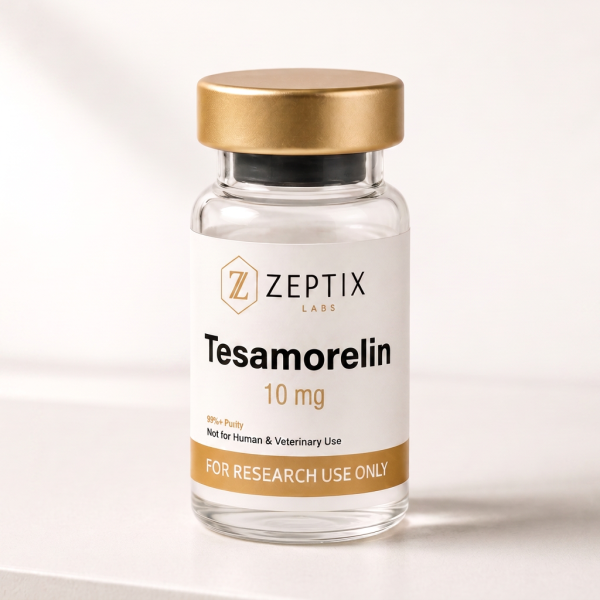
Zeptix Labs tesamorelin is for qualified laboratory research. It is not a prescription product and is not for human or veterinary use.
Research context and evidence base
Tesamorelin literature includes receptor pharmacology and studies of a regulated prescription formulation. A research-grade vial is not that approved drug product. Investigators should distinguish GHRH-receptor activity, downstream endocrine markers, formulation, population, and regulatory context before deciding whether a paper informs a laboratory question.12
How to interpret the published evidence
For this topic, the word “benefit” should be translated into a specific measured outcome. Cell-signaling changes, animal histology, pharmacokinetic movement, and validated clinical endpoints sit at different levels of evidence. They cannot be combined into one general promise. Read the population, model, control group, endpoint definition, and statistical limits before drawing a conclusion.3
Experimental design questions
Tesamorelin studies should distinguish receptor-level activity from downstream GH or IGF-1 measurements and from body-composition endpoints used in regulated clinical trials. An intact pituitary axis, formulation, sampling schedule, and comparator all affect interpretation. Research material should not be evaluated by copying a prescription-product administration schedule.
Building a reproducible laboratory record
For work involving Tesamorelin Benefits, record the supplier, SKU, lot number, labeled amount, receipt date, storage history, reconstitution conditions, concentration calculation, control material, instrument or assay version, and prespecified endpoint. Keep the matching certificate of analysis with the run record. These details make a result auditable and help distinguish biological variation from a handling or identity problem.
- Match the exact compound, sequence, modification, and formulation to the cited methods.
- Use positive, negative, and vehicle controls appropriate to the assay.
- Define concentrations, time points, exclusions, and endpoints before reviewing results.
- Report null and unexpected findings alongside the planned readouts.
Quality, limitations, and research-use status
A certificate of analysis supports lot traceability but does not establish a biological outcome. Investigators remain responsible for method suitability, independent confirmation when required, and compliance with institutional rules. Zeptix Labs materials are supplied for qualified laboratory research only and are not drugs, supplements, cosmetics, foods, or materials for human or veterinary administration.
Reporting results without overreach
When reporting Tesamorelin Benefits, state what the experiment directly measured and keep interpretation within that boundary. Include model limitations, uncertainty, failed quality controls, and alternative explanations. Avoid turning preclinical observations into treatment language or assuming that a statistically significant marker change is biologically important. Clear limitations make the article more useful to researchers and prevent laboratory evidence from being mistaken for consumer guidance.
References
- Falutz, J., et al. “Metabolic Effects of a Growth Hormone–Releasing Factor in Patients with HIV.” New England Journal of Medicine 357, no. 23 (2007): 2359–70. https://pubmed.ncbi.nlm.nih.gov/18057338/
- Falutz, J., et al. “Effects of Tesamorelin, a Growth Hormone–Releasing Factor, in HIV-Infected Patients with Abdominal Fat Accumulation: A Randomized Placebo-Controlled Trial with a Safety Extension.” Journal of Acquired Immune Deficiency Syndromes 53, no. 3 (2010): 311–22. https://pubmed.ncbi.nlm.nih.gov/20101189/
- Spooner, L. M., and Olin, J. L. “Tesamorelin: A Growth Hormone–Releasing Factor Analogue for HIV-Associated Lipodystrophy.” Annals of Pharmacotherapy 46, no. 2 (2012): 240–47. https://pubmed.ncbi.nlm.nih.gov/22274143/
- U.S. National Library of Medicine. EGRIFTA WR (tesamorelin) Prescribing Information. DailyMed. Revised March 2025. https://dailymed.nlm.nih.gov/dailymed/drugInfo.cfm?setid=839334d3-8c1d-4c26-9036-2ab524a6ea75
- González-Sales M, Barrière O, Tremblay PO, Nekka F, Desrochers J. Population pharmacokinetic analysis of tesamorelin in HIV-infected patients and healthy subjects. Clinical Pharmacokinetics. 2015;54(3):303–313. https://pubmed.ncbi.nlm.nih.gov/25358450/
- González-Sales M, Barrière O, Tremblay PO, Nekka F, Desrochers J. Population pharmacokinetic and pharmacodynamic analysis of tesamorelin and its effects on growth hormone and insulin-like growth factor 1. Journal of Pharmacokinetics and Pharmacodynamics. 2015;42(3):287–299. PMID: 25895899. 2015. https://pubmed.ncbi.nlm.nih.gov/25895899/
- Zhou F, Zhang H, Cong Z, et al. Structural basis for activation of the growth hormone-releasing hormone receptor. Nature Communications. 2020;11(1):5205. https://pubmed.ncbi.nlm.nih.gov/33060564/
- Rivier J, Spiess J, Thorner MO, Vale W. Characterization of a growth hormone-releasing factor from a human pancreatic islet tumour. Nature. 1982;300(5889):276–278. https://pubmed.ncbi.nlm.nih.gov/6292724/
- Guillemin R, Brazeau P, Bohlen P, et al. Growth hormone-releasing factor from a human pancreatic tumor that caused acromegaly. Science. 1982;218(4572):585–587. https://pubmed.ncbi.nlm.nih.gov/6812220/
- Falutz J, Mamputu JC, Potvin D, et al. Effects of tesamorelin in HIV-infected patients with excess abdominal fat: pooled analysis of two multicenter, double-blind, placebo-controlled Phase 3 trials with safety-extension data. Journal of Clinical Endocrinology & Metabolism. 2010;95(9):4291–4304. https://pubmed.ncbi.nlm.nih.gov/20554713/