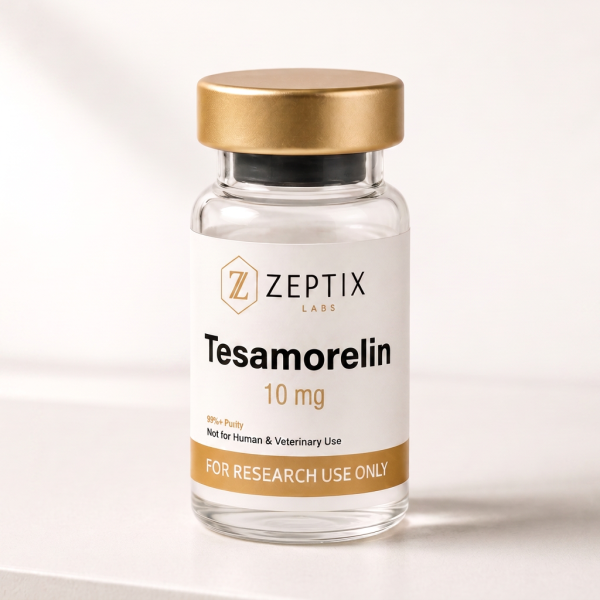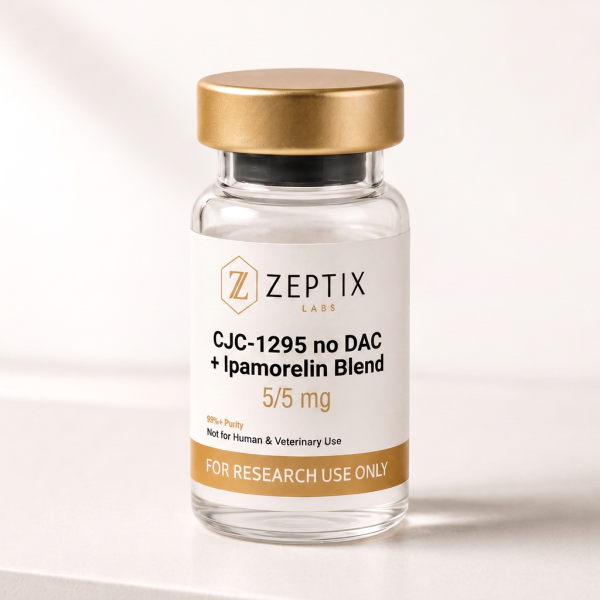


Disclaimer: Information is for research and educational purposes only. Catalog materials are not approved for human or veterinary use.
Tesamorelin and sermorelin are both analogs of growth-hormone-releasing hormone (GHRH), and both act at the GHRH receptor on pituitary cells.1 The differences are structural: how much of the native 44-amino-acid hormone each one keeps, and what has been changed to keep it from being cut apart in plasma. CJC-1295 without DAC belongs in the same comparison, because it answers the same problem a third way.
The three side by side
| Tesamorelin | Sermorelin | CJC-1295 no DAC | |
|---|---|---|---|
| Sequence | GHRH(1-44) with a trans-3-hexenoyl group on the N-terminus | GHRH(1-29) amide, the shortest fragment that keeps activity | GHRH(1-29) with four amino acid substitutions |
| Length | 44 amino acids | 29 amino acids | 29 amino acids |
| Molar mass | about 5,136 g/mol | about 3,358 g/mol | about 3,368 g/mol |
| How it resists DPP-4 | The N-terminal acyl group | It does not; it is cut quickly | Substitutions including D-alanine at position 2 |
| In the Zeptix catalog | Yes, as a research peptide | No | In the CJC-1295 no DAC + Ipamorelin blend |
Sermorelin is not sold here. It is in the comparison because it is the reference point the others are designed against, and because the two names are searched together.
The problem all three are solving
Native GHRH is short-lived in plasma. The main route is dipeptidyl peptidase IV, which cuts the bond between the second and third amino acids; work characterizing that cleavage showed GHRH(1-44), GHRH(1-29) and related fragments were all rapidly converted to the 3-44 metabolite, and that a D-amino acid at position 1 or 2 prevented the hydrolysis.2
Each analog answers it differently. Tesamorelin keeps the whole 44-amino-acid sequence and blocks the N-terminus with an acyl group. Sermorelin keeps only the part of the hormone needed for receptor activity and accepts the short life. CJC-1295 without DAC substitutes amino acids, D-alanine at position 2 among them, so the protease has nothing to work with.
What the literature covers
Tesamorelin has the most developed record of the three, because a prescription product containing it went through clinical trials in a specific approved indication, and non-clinical pharmacology and safety work on the same molecule was published alongside it.34 That is a regulated drug product, not a research vial, and the distinction matters: a research peptide is not that approved medicine, and the trial results describe the medicine's population and design.
Sermorelin's literature is older and mostly describes its short duration of action and its use as a GHRH reference.5 CJC-1295 is more confusing. The published human pharmacokinetics are for the DAC version, an albumin-binding conjugate with an estimated half-life of about six to eight days.67 The product sold as CJC-1295 no DAC does not carry that modification, so those numbers do not describe it.
Nothing on this page describes an outcome in people from a research-grade vial. The clinical work cited concerns regulated pharmaceutical products, and catalog materials are not approved for human or veterinary use.
Why the molar masses matter
The three masses differ by more than a third. One milligram of sermorelin is about 0.30 micromoles; one milligram of tesamorelin is about 0.19 micromoles. Comparing equal masses compares different numbers of molecules at the same receptor, which quietly builds a dose difference into the experiment. Work in molar amounts, and take net peptide content from the certificate of analysis rather than assuming the labeled vial mass is all peptide.
Choosing one for a protocol
- Reproducing a published GHRH study: use the same analog that study used. The three are not interchangeable in a methods section.
- Asking whether the full-length sequence matters: run tesamorelin against a 1-29 analog with everything else held constant.
- Asking about protease resistance: the comparison needs an unmodified fragment in the same experiment, not just the stabilized ones.
- Working on receptor pharmacology: a GHRH analog activates the GHRH receptor; a ghrelin-receptor peptide such as ipamorelin does not, so the two answer different questions.
- Running anything with a blend: record what each lot contains, since a blend's composition is defined per lot.
Tesamorelin and the CJC-1295 no DAC + Ipamorelin blend from Zeptix Labs are supplied for qualified laboratory research only. They are not drugs, supplements or compounded preparations, and are not for human or veterinary use.
Frequently asked questions
What is the difference between tesamorelin and sermorelin?
Tesamorelin keeps the full 44-amino-acid GHRH sequence with a trans-3-hexenoyl group on the N-terminus that resists DPP-4 cleavage. Sermorelin is the 29-amino-acid fragment with no such protection, so it is cut much faster in plasma.
Do tesamorelin and sermorelin act on the same receptor?
Yes. Both are GHRH analogs acting at the GHRH receptor on pituitary somatotrophs. The structural differences change stability and duration, not the receptor.
How does CJC-1295 no DAC fit in?
It is a GHRH(1-29) analog with amino acid substitutions, D-alanine at position 2 among them, that resist DPP-4. The published human half-life figures of about six to eight days are for the DAC version, which carries an albumin-binding group the no DAC form does not have.
Does Zeptix Labs sell sermorelin?
No. The catalog lists tesamorelin and a CJC-1295 no DAC + Ipamorelin blend. Sermorelin appears here only as the comparison the other analogs are designed against.
References
- Mayo KE. Molecular cloning and expression of a pituitary-specific receptor for growth hormone-releasing hormone. Mol Endocrinol. 1992;6(10):1734-1744. https://doi.org/10.1210/mend.6.10.1333056
- Frohman LA, Downs TR, Heimer EP, Felix AM. Dipeptidylpeptidase IV and trypsin-like enzymatic degradation of human growth hormone-releasing hormone in plasma. J Clin Invest. 1989;83(5):1533-1540. https://doi.org/10.1172/JCI114049
- Falutz J, Allas S, Blot K, et al. Metabolic effects of a growth hormone-releasing factor in patients with HIV. N Engl J Med. 2007;357(23):2359-2370. https://doi.org/10.1056/NEJMoa072375
- Ferdinandi ES, Brazeau P, High K, et al. Non-clinical pharmacology and safety evaluation of TH9507, a human growth hormone-releasing factor analogue. Basic Clin Pharmacol Toxicol. 2007;100(1):49-58. https://doi.org/10.1111/j.1742-7843.2007.00008.x
- Prakash A, Goa KL. Sermorelin: a review of its use in the diagnosis and treatment of children with idiopathic growth hormone deficiency. BioDrugs. 1999;12(2):139-157. https://doi.org/10.2165/00063030-199912020-00007
- Jette L, Leger R, Thibaudeau K, et al. Human growth hormone-releasing factor (hGRF)1-29-albumin bioconjugates activate the GRF receptor on the anterior pituitary in rats: identification of CJC-1295 as a long-lasting GRF analog. Endocrinology. 2005;146(7):3052-3058. https://doi.org/10.1210/en.2004-1286
- Teichman SL, Neale A, Lawrence B, et al. Prolonged stimulation of growth hormone (GH) and insulin-like growth factor I secretion by CJC-1295, a long-acting analog of GH-releasing hormone, in healthy adults. J Clin Endocrinol Metab. 2006;91(3):799-805. https://doi.org/10.1210/jc.2005-1536