
Disclaimer: Information is for research and educational purposes only. Catalog materials are not approved for human or veterinary use.
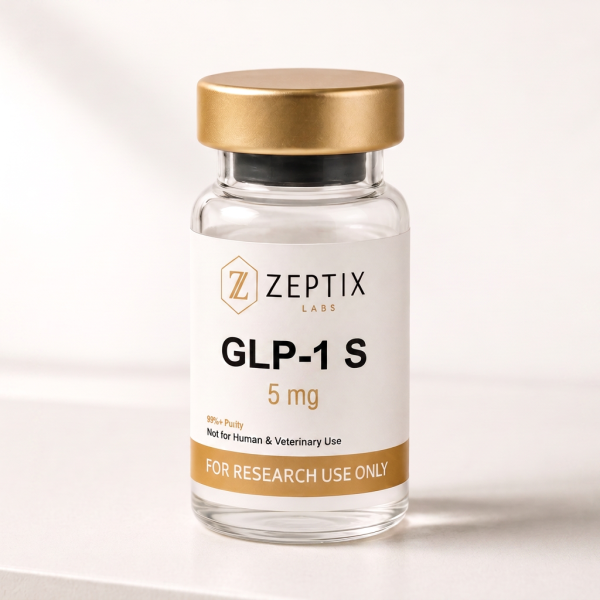
GLP-1 S is listed for qualified research involving GLP-1 receptor models, incretin signaling, and metabolic pathway comparisons. The name is the catalog identifier. Confirm the lot identity against the COA before the material enters an assay.
Laboratory, not pharmacy
GLP-1 receptor agonists exist as approved drugs under other names and regulatory files. A research-use catalog item is not that product. Zeptix Labs GLP-1 S is not sold for treatment, compounding, or any non-laboratory purpose.
Typical experimental themes
- GLP-1 receptor signaling and downstream pathway activity.
- Glucose-response and beta-cell marker models.
- Motility and energy-balance signaling in research systems.
For research use only. Not for human or veterinary use.
Research context and evidence base
Incretin-family research can involve GLP-1, GLP-2, GIP, glucagon, or multi-receptor analogs. These targets overlap in metabolic discussions but are not interchangeable. Receptor profile, species, assay format, exposure period, and downstream endpoint must be matched to the exact compound named in a publication.12
How to interpret the published evidence
Evidence should be sorted by study type before it is summarized. Analytical characterization establishes what material was tested; cell work can suggest pathways; animal models can explore integrated biology; and human studies, when they exist, apply only to their regulated product, population, and design. One layer should not be presented as if it proves the next.3
Experimental design questions
Incretin and multi-receptor studies should characterize activity at each intended receptor rather than infer a profile from the compound name. Single-receptor comparators, matched exposure, and pathway-specific readouts help explain a composite result. GLP-1, GLP-2, GIP, and glucagon systems also require different biological models when the endpoint extends beyond receptor binding.
Building a reproducible laboratory record
For work involving What Is GLP-1 S, record the supplier, SKU, lot number, labeled amount, receipt date, storage history, reconstitution conditions, concentration calculation, control material, instrument or assay version, and prespecified endpoint. Keep the matching certificate of analysis with the run record. These details make a result auditable and help distinguish biological variation from a handling or identity problem.
- Match the exact compound, sequence, modification, and formulation to the cited methods.
- Use positive, negative, and vehicle controls appropriate to the assay.
- Define concentrations, time points, exclusions, and endpoints before reviewing results.
- Report null and unexpected findings alongside the planned readouts.
Quality, limitations, and research-use status
A certificate of analysis supports lot traceability but does not establish a biological outcome. Investigators remain responsible for method suitability, independent confirmation when required, and compliance with institutional rules. Zeptix Labs materials are supplied for qualified laboratory research only and are not drugs, supplements, cosmetics, foods, or materials for human or veterinary administration.
Reporting results without overreach
When reporting What Is GLP-1 S, state what the experiment directly measured and keep interpretation within that boundary. Include model limitations, uncertainty, failed quality controls, and alternative explanations. Avoid turning preclinical observations into treatment language or assuming that a statistically significant marker change is biologically important. Clear limitations make the article more useful to researchers and prevent laboratory evidence from being mistaken for consumer guidance.
References
- Drucker, D. J. “Mechanisms of Action and Therapeutic Application of Glucagon-like Peptide-1.” Cell Metabolism 27, no. 4 (2018): 740–756. https://pubmed.ncbi.nlm.nih.gov/29617641/
- Baggio, L. L., and Drucker, D. J. “Biology of Incretins: GLP-1 and GIP.” Gastroenterology 132, no. 6 (2007): 2131–2157. https://pubmed.ncbi.nlm.nih.gov/17498508/
- Drucker, D. J., and Yusta, B. “Physiology and Pharmacology of the Enteroendocrine Hormone Glucagon-like Peptide-2.” Annual Review of Physiology 76 (2014): 561–583. https://pubmed.ncbi.nlm.nih.gov/24161075/
- Coskun, T., et al. “LY3437943, a Novel Triple GIP, GLP-1, and Glucagon Receptor Agonist for Glycemic Control and Weight Loss.” Cell Metabolism 34, no. 9 (2022): 1234–1247. https://pubmed.ncbi.nlm.nih.gov/35985323/
- Jastreboff, A. M., et al. “Triple-Hormone-Receptor Agonist Retatrutide for Obesity: A Phase 2 Trial.” New England Journal of Medicine 389 (2023): 514–526. https://pubmed.ncbi.nlm.nih.gov/37366315/