

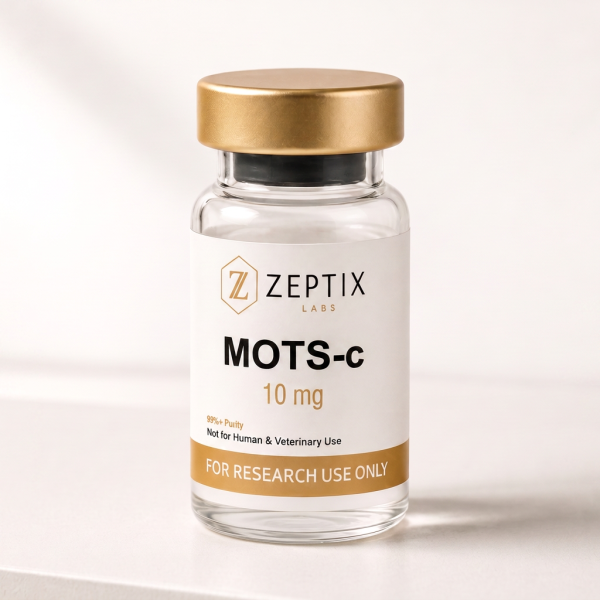
Disclaimer: Information is for research and educational purposes only. Catalog materials are not approved for human or veterinary use.
MOTS-c is a short peptide encoded in mitochondrial DNA, often described as a mitochondria-derived peptide. Laboratory work has used it in models of cellular energy regulation, nutrient sensing, and metabolic stress. Zeptix Labs supplies MOTS-c for research use only.
Why mitochondria-derived peptides are interesting
Most catalog peptides are nuclear-gene or fully synthetic sequences. MOTS-c is discussed as a signal that originates from the mitochondrial genome. That origin is why it appears in papers on AMPK-related pathways, exercise-mimetic markers, and metabolic adaptation. It always shows up as experimental biology, never as a consumer product story.
Typical readouts
- Mitochondrial signaling and cellular-energy models.
- Nutrient-sensing and substrate-utilization markers.
- Oxidative-stress and AMPK-related pathway work.
MOTS-c is not for human or veterinary use. Handle only in suitable laboratory environments.
Research context and evidence base
MOTS-c is studied as a mitochondria-encoded peptide associated with cellular stress responses, nutrient sensing, AMPK-related signaling, and metabolic adaptation. The literature includes cell, animal, and limited translational observations. Each layer answers a different question, so model type and endpoint should remain visible whenever findings are summarized.12
How to interpret the published evidence
Evidence should be sorted by study type before it is summarized. Analytical characterization establishes what material was tested; cell work can suggest pathways; animal models can explore integrated biology; and human studies, when they exist, apply only to their regulated product, population, and design. One layer should not be presented as if it proves the next.3
Experimental design questions
MOTS-c protocols commonly need controls for metabolic stress, nutrient conditions, cell density, mitochondrial function, and assay timing. AMPK phosphorylation, transcriptional movement, glucose handling, and exercise-related outcomes are not substitutes for one another. Because mitochondrial signaling is sensitive to culture and organism conditions, replication should preserve the original model as closely as possible.
Building a reproducible laboratory record
For work involving What Is MOTS-c, record the supplier, SKU, lot number, labeled amount, receipt date, storage history, reconstitution conditions, concentration calculation, control material, instrument or assay version, and prespecified endpoint. Keep the matching certificate of analysis with the run record. These details make a result auditable and help distinguish biological variation from a handling or identity problem.
- Match the exact compound, sequence, modification, and formulation to the cited methods.
- Use positive, negative, and vehicle controls appropriate to the assay.
- Define concentrations, time points, exclusions, and endpoints before reviewing results.
- Report null and unexpected findings alongside the planned readouts.
Quality, limitations, and research-use status
A certificate of analysis supports lot traceability but does not establish a biological outcome. Investigators remain responsible for method suitability, independent confirmation when required, and compliance with institutional rules. Zeptix Labs materials are supplied for qualified laboratory research only and are not drugs, supplements, cosmetics, foods, or materials for human or veterinary administration.
Reporting results without overreach
When reporting What Is MOTS-c, state what the experiment directly measured and keep interpretation within that boundary. Include model limitations, uncertainty, failed quality controls, and alternative explanations. Avoid turning preclinical observations into treatment language or assuming that a statistically significant marker change is biologically important. Clear limitations make the article more useful to researchers and prevent laboratory evidence from being mistaken for consumer guidance.
References
- Lee C, et al. “The mitochondrial-derived peptide MOTS-c promotes metabolic homeostasis and reduces obesity and insulin resistance.” Cell Metab. 2015;21(3):443–454. https://pubmed.ncbi.nlm.nih.gov/25738459/
- Reynolds JC, et al. “MOTS-c is an exercise-induced mitochondrial-encoded regulator of age-dependent physical decline.” Nat Commun. 2021;12:470. https://pubmed.ncbi.nlm.nih.gov/33563973/
- Zarse K, Ristow M. “Mitochondrial peptides and aging: a new perspective.” Exp Gerontol. 2020;130:110791. https://pubmed.ncbi.nlm.nih.gov/31731158/
- Lu H, et al. “Mitochondrial-derived peptide MOTS-c increases healthspan and lifespan in mice.” Aging Cell. 2019;18(6):e13030. https://pubmed.ncbi.nlm.nih.gov/31608986/
- Quevedo H, et al. “MOTS-c clinical potential in metabolic disease and aging.” Front Endocrinol. 2022;13:890123. https://pubmed.ncbi.nlm.nih.gov/35669234/
- Lee C, Zeng J, Drew BG, et al. The mitochondrial-derived peptide MOTS-c promotes metabolic homeostasis and reduces obesity and insulin resistance. Cell Metab. 2015;21(3):443-454. https://pubmed.ncbi.nlm.nih.gov/25738459 https://pubmed.ncbi.nlm.nih.gov/25738459/?utm_source=chatgpt.com
- Kim KH, Son JM, Benayoun BA, Lee C. The mitochondrial-encoded peptide MOTS-c translocates to the nucleus to regulate nuclear gene expression in response to metabolic stress. Cell Metab. 2018;28(4):516-524.e7. https://pubmed.ncbi.nlm.nih.gov/29983246/ https://pubmed.ncbi.nlm.nih.gov/29983246/?utm_source=chatgpt.com
- Reynolds JC, Mazzucco AE, Chen CY, et al. MOTS-c is an exercise-induced mitochondrial-encoded regulator of age-dependent physical decline and muscle homeostasis. Nat Commun. 2021;12:470. https://pubmed.ncbi.nlm.nih.gov/33473109 https://pubmed.ncbi.nlm.nih.gov/33473109/?utm_source=chatgpt.com
- D’Souza RF, Woodhead JST, Zeng N, et al. Increased expression of the mitochondrial derived peptide, MOTS-c, in skeletal muscle of healthy aging men is associated with myofiber composition. Aging (Albany NY). 2020;12(6):5244-5265. https://pubmed.ncbi.nlm.nih.gov/32182209 https://pubmed.ncbi.nlm.nih.gov/32182209/?utm_source=chatgpt.com
- Yu WD, Wang HB, Teng L, et al. MOTS-c promotes mitochondrial homeostasis in human placenta-derived mesenchymal stem cells via AMPK activation and mTORC1 inhibition. J Tissue Eng Regen Med. 2021;15(3):254-267. https://pubmed.ncbi.nlm.nih.gov/33639272 https://pubmed.ncbi.nlm.nih.gov/33639272/?utm_source=chatgpt.com