
Disclaimer: Information is for research and educational purposes only. Catalog materials are not approved for human or veterinary use.
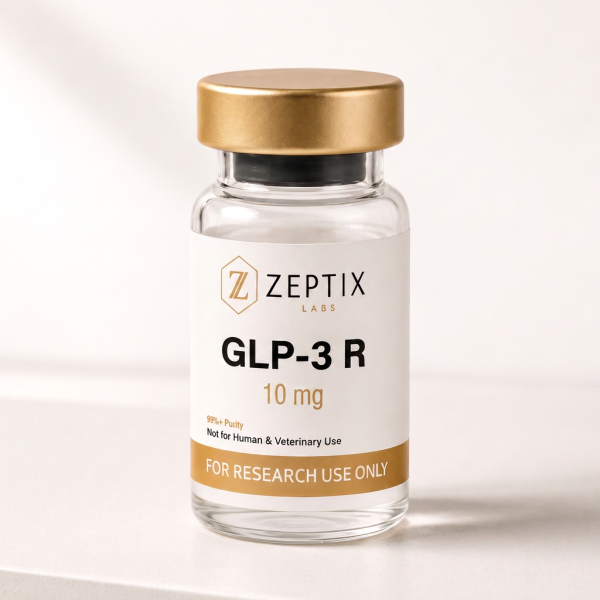
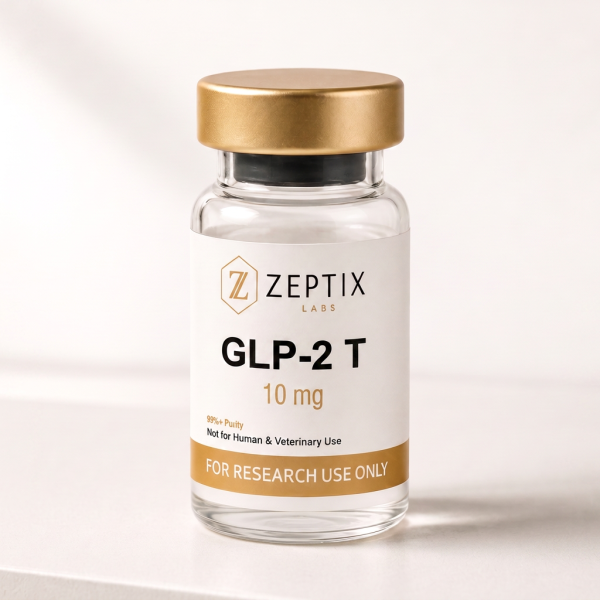
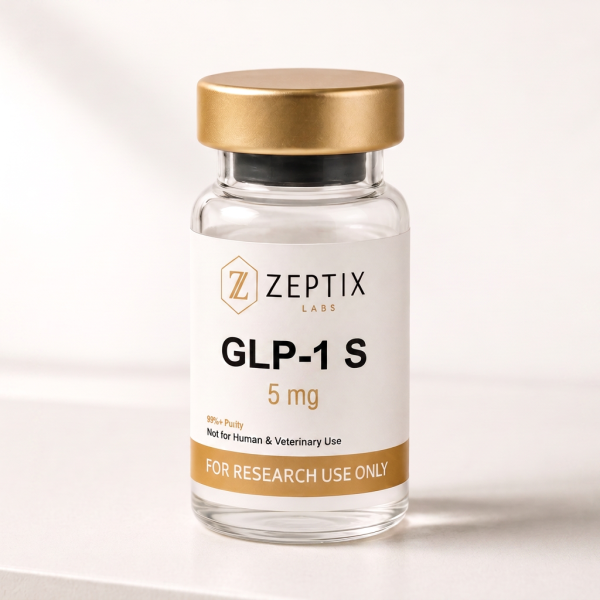
Semaglutide, tirzepatide and retatrutide are the three incretin-family peptides that come up most in current metabolic research. The simplest way to tell them apart is to count receptors. Semaglutide activates one, tirzepatide two and retatrutide three. Zeptix Labs lists them as GLP-1 S, GLP-2 T and GLP-3 R, and the number in each catalog name is that receptor count.
That naming has one trap worth flagging early: GLP-2 T is not glucagon-like peptide-2. GLP-2 is a separate intestinal hormone with its own receptor and literature. The "2" in GLP-2 T only counts the receptors tirzepatide acts on.
The three compounds side by side
| GLP-1 S (semaglutide) | GLP-2 T (tirzepatide) | GLP-3 R (retatrutide) | |
|---|---|---|---|
| Receptors | GLP-1R | GIPR and GLP-1R | GIPR, GLP-1R and glucagon receptor |
| Backbone | GLP-1 analog, 31 amino acids | GIP-based, 39 amino acids | GIP-based, 39 amino acids |
| Molecular formula | C187H291N45O59 | C225H348N48O68 | C221H342N46O68 |
| Molar mass | 4113.6 g/mol | 4813.5 g/mol | 4731.3 g/mol |
| Albumin binder | C18 fatty diacid | C20 fatty diacid | C20 fatty diacid |
| CAS number | 910463-68-2 | 2023788-19-2 | 2381089-83-2 |
All three carry a fatty diacid side chain that binds serum albumin. That is what gives the regulated drug versions their long half-lives, roughly a week for semaglutide and five to six days for tirzepatide and retatrutide in published pharmacology studies.124 In a laboratory it has a more immediate consequence: how much serum is in the medium changes how much free peptide reaches the receptor.
GLP-1 S: one receptor (semaglutide)
Semaglutide is an analog of human GLP-1(7-37). Two changes do most of the work. An aminoisobutyric acid (Aib) at position 8 protects the N-terminus from cleavage by DPP-4, the enzyme that inactivates native GLP-1 within minutes, and the C18 diacid attached through a linker on lysine 26 binds albumin.1
Because it acts on GLP-1R alone, GLP-1 S is the natural reference agonist in a receptor panel. If a readout moves with GLP-1 S, a GLP-1R explanation is on the table; if it moves only with the multi-receptor compounds, the extra receptors become the question.
GLP-2 T: two receptors (tirzepatide)
Tirzepatide is built on the GIP sequence rather than GLP-1, and it activates both the GIP receptor and the GLP-1 receptor. It is not an even split. Characterization work describes it as imbalanced, with potency at GIPR close to native GIP but weaker activity at GLP-1R than native GLP-1, and as biased at GLP-1R toward cAMP signaling over beta-arrestin recruitment.23
That profile makes GLP-2 T the compound for questions about what GIP receptor activity adds on top of GLP-1 signaling. Comparing it with GLP-1 S in the same assay, at matched molar concentrations, is the usual design.
GLP-3 R: three receptors (retatrutide)
Retatrutide, first described as LY3437943, adds the glucagon receptor to the GIP and GLP-1 pair. Its discovery paper reports higher potency than native GIP at the human GIP receptor and lower potency than the native hormones at GLP-1R and the glucagon receptor.4
The glucagon arm is what sets it apart. Glucagon receptor signaling brings hepatic glucose output, lipid handling and energy expenditure into the picture, so studies with GLP-3 R usually need readouts and controls for that receptor as well, such as a glucagon receptor antagonist or cells that lack the receptor.
Choosing a compound for a study
- Start from the receptor question. GLP-1R alone points to GLP-1 S. The contribution of GIPR points to GLP-2 T, compared against GLP-1 S. The glucagon receptor points to GLP-3 R.
- Match molar concentrations, not milligrams. The molar masses differ by up to 17%. One milligram is 0.243 µmol of semaglutide, 0.208 µmol of tirzepatide and 0.211 µmol of retatrutide. Equal mass is not an equal number of molecules.
- Report the serum or albumin content. All three bind albumin, so free concentration depends on the medium. A potency measured in serum-free buffer will not match one measured in 10% serum.
- Isolate receptors with controls. Receptor-specific antagonists, knockout or non-expressing cell lines and single-receptor reference agonists keep a multi-receptor result interpretable.
- Keep one COA per compound. These are different molecules. A COA for one lot says nothing about another product in the series.
What the clinical literature is and is not
All three molecules have large clinical trial programs behind their regulated drug versions.567 Those trials studied specific pharmaceutical products, made under drug manufacturing controls, in defined patient groups under medical supervision. Their results describe those products only. They are useful background for designing laboratory experiments, but they do not transfer to research materials, and nothing in them makes a research compound suitable for people.
GLP-1 S, GLP-2 T and GLP-3 R are supplied for laboratory research only. They are not medicines, compounded preparations or supplements, and are not for human or veterinary use.
Frequently asked questions
Is GLP-2 T the same as GLP-2?
No. GLP-2 is a separate intestinal hormone. GLP-2 T is the Zeptix Labs catalog name for tirzepatide, and the 2 counts the receptors it acts on: GIP and GLP-1.
Which one acts on the glucagon receptor?
Only retatrutide (GLP-3 R). Semaglutide acts on the GLP-1 receptor alone, and tirzepatide on the GIP and GLP-1 receptors.
Can the three be compared milligram for milligram?
Not accurately. Their molar masses range from about 4,114 to 4,814 g/mol, so equal masses contain different numbers of molecules. Compare them at matched molar concentrations.
References
- Lau J, Bloch P, Schäffer L, et al. Discovery of the once-weekly glucagon-like peptide-1 (GLP-1) analogue semaglutide. J Med Chem. 2015;58(18):7370-7380. https://doi.org/10.1021/acs.jmedchem.5b00726
- Coskun T, Sloop KW, Loghin C, et al. LY3298176, a novel dual GIP and GLP-1 receptor agonist for the treatment of type 2 diabetes mellitus: from discovery to clinical proof of concept. Mol Metab. 2018;18:3-14. https://doi.org/10.1016/j.molmet.2018.09.009
- Willard FS, Douros JD, Gabe MB, et al. Tirzepatide is an imbalanced and biased dual GIP and GLP-1 receptor agonist. JCI Insight. 2020;5(17):e140532. https://doi.org/10.1172/jci.insight.140532
- Coskun T, Urva S, Roell WC, et al. LY3437943, a novel triple glucagon, GIP, and GLP-1 receptor agonist for glycemic control and weight loss: from discovery to clinical proof of concept. Cell Metab. 2022;34(9):1234-1247. https://doi.org/10.1016/j.cmet.2022.07.013
- Wilding JPH, Batterham RL, Calanna S, et al. Once-weekly semaglutide in adults with overweight or obesity. N Engl J Med. 2021;384(11):989-1002. https://doi.org/10.1056/NEJMoa2032183
- Jastreboff AM, Aronne LJ, Ahmad NN, et al. Tirzepatide once weekly for the treatment of obesity. N Engl J Med. 2022;387(3):205-216. https://doi.org/10.1056/NEJMoa2206038
- Jastreboff AM, Kaplan LM, Frías JP, et al. Triple-hormone-receptor agonist retatrutide for obesity: a phase 2 trial. N Engl J Med. 2023;389(6):514-526. https://doi.org/10.1056/NEJMoa2301972