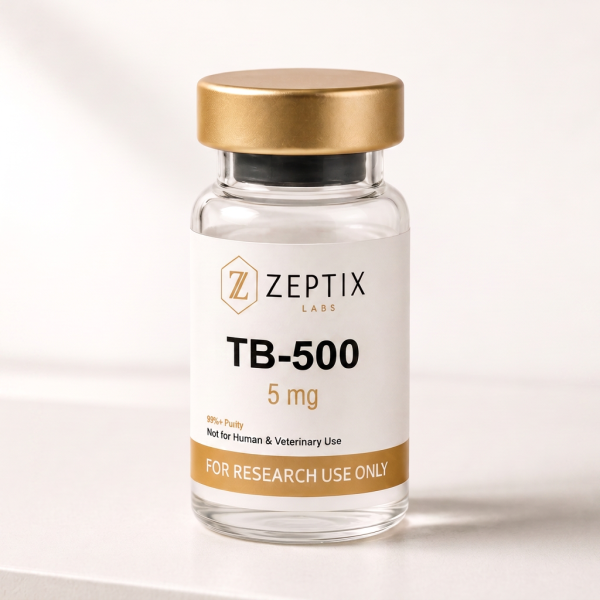

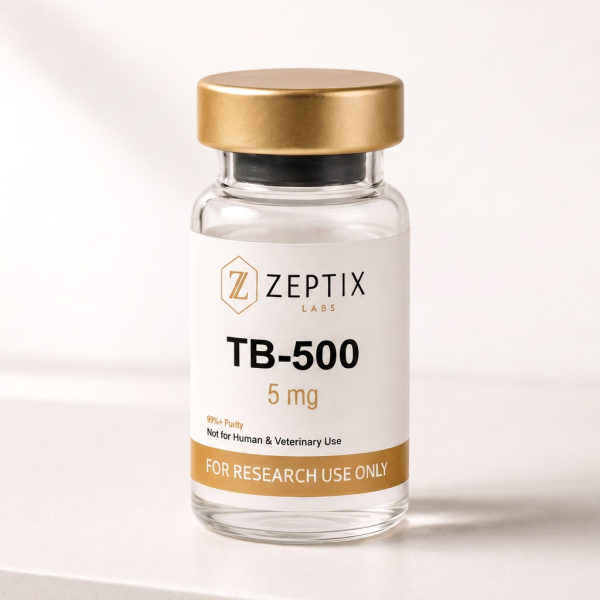
Disclaimer: Information is for research and educational purposes only. Catalog materials are not approved for human or veterinary use.
Thymosin beta-4 is a natural 43-amino-acid peptide, and most of the published research is about it. TB-500 is a market name, and it is used for more than one molecule: sometimes a synthetic copy of the whole thymosin beta-4 sequence, sometimes a short fragment of it. Results from one cannot simply be cited for the other, so it is worth knowing which molecule a paper used and which one a vial contains.
Three molecules, one family
| Thymosin beta-4 | Ac-LKKTETQ | Ac-SDKP | |
|---|---|---|---|
| Length | 43 amino acids | 7 amino acids | 4 amino acids |
| Position in thymosin beta-4 | 1 to 43 | 17 to 23 | 1 to 4 |
| Molar mass | about 4,963 g/mol | about 889 g/mol | about 488 g/mol |
| Main research themes | G-actin binding, cell migration, wound and corneal models | The actin-binding region on its own | A separate literature on fibrosis and inflammation |
All three are N-terminally acetylated, which is what the "Ac" stands for.
Thymosin beta-4, the full peptide
Thymosin beta-4 (Ac-SDKPDMAEIEKFDKSKLKKTETQEKNPLPSKETIEQEKQAGES) is the most abundant of the beta-thymosins. It binds monomeric G-actin one to one and holds it back from forming filaments, which makes it a major regulator of the actin cytoskeleton.12 Most research built on that role, in cell migration, angiogenesis and wound and corneal models, used the full-length peptide.34
LKKTETQ, the actin-binding region
Residues 17 to 23, LKKTETQ, form the central actin-binding motif. A synthetic acetylated version of this seven-amino-acid stretch is one of the molecules sold as TB-500, and analytical chemists working on detection methods describe TB-500 in exactly those terms.5 It is a fraction of the size of the full peptide, and it lacks the rest of the sequence, including the N-terminal region that gives rise to Ac-SDKP.
Ac-SDKP, the N-terminal tetrapeptide
The enzyme prolyl oligopeptidase can release the first four amino acids of thymosin beta-4 as Ac-SDKP, which is broken down in turn by angiotensin-converting enzyme. Ac-SDKP has its own research literature, mostly in fibrosis and inflammation models, and should be treated as a separate compound.6
How to tell which one you have
- Check the mass on the COA. Mass spectrometry separates them easily: about 4,963 Da means full-length thymosin beta-4, about 889 Da means the Ac-LKKTETQ fragment.
- Read the sequence, not just the name. A methods section or a label that gives the sequence settles it; "TB-500" alone does not.
- Match the paper. Before citing a study as background, confirm it used the same molecule as your lot.
Study design notes
- Use molar amounts. One milligram is about 0.20 µmol of full-length thymosin beta-4 but about 1.12 µmol of the heptapeptide, more than five times as many molecules.
- Add a scrambled control. A peptide with the same amino acids in a shuffled order tests whether an effect depends on the actual sequence.
- Measure actin directly where you can. G-actin and F-actin ratios or polymerization assays tie a result to the known mechanism.
TB-500 from Zeptix Labs is for laboratory research only and is not for human or veterinary use.
Frequently asked questions
Is TB-500 the same as thymosin beta-4?
Not always. TB-500 is a market name used both for synthetic full-length thymosin beta-4 (43 amino acids) and for its acetylated actin-binding fragment Ac-LKKTETQ (7 amino acids). Check the sequence or the mass on the COA.
What is LKKTETQ?
Residues 17 to 23 of thymosin beta-4, the central actin-binding region. Its acetylated form is one of the molecules sold as TB-500.
How can a COA show which form a vial contains?
By the mass from mass spectrometry: about 4,963 Da for full-length thymosin beta-4 and about 889 Da for the Ac-LKKTETQ fragment.
References
- Safer D, Elzinga M, Nachmias VT. Thymosin beta 4 and Fx, an actin-sequestering peptide, are indistinguishable. J Biol Chem. 1991;266(7):4029-4032. https://pubmed.ncbi.nlm.nih.gov/1999398/
- Huff T, Müller CS, Otto AM, Netzker R, Hannappel E. Beta-thymosins, small acidic peptides with multiple functions. Int J Biochem Cell Biol. 2001;33(3):205-220. https://doi.org/10.1016/S1357-2725(00)00087-X
- Goldstein AL, Hannappel E, Sosne G, Kleinman HK. Thymosin β4: a multi-functional regenerative peptide. Basic properties and clinical applications. Expert Opin Biol Ther. 2012;12(1):37-51. https://doi.org/10.1517/14712598.2012.634793
- Sosne G, Qiu P, Christopherson PL, Wheater MK. Thymosin beta 4 suppression of corneal NFkappaB: a potential anti-inflammatory pathway. Exp Eye Res. 2007;84(4):663-669. https://pubmed.ncbi.nlm.nih.gov/17254567/
- Ho ENM, Kwok WH, Lau MY, et al. Doping control analysis of TB-500, a synthetic version of an active region of thymosin β4, in equine urine and plasma by liquid chromatography-mass spectrometry. J Chromatogr A. 2012;1265:57-69. https://doi.org/10.1016/j.chroma.2012.09.043
- Cavasin MA, Rhaleb NE, Yang XP, Carretero OA. Prolyl oligopeptidase is involved in release of the antifibrotic peptide Ac-SDKP. Hypertension. 2004;43(5):1140-1145. https://doi.org/10.1161/01.HYP.0000126172.01673.84