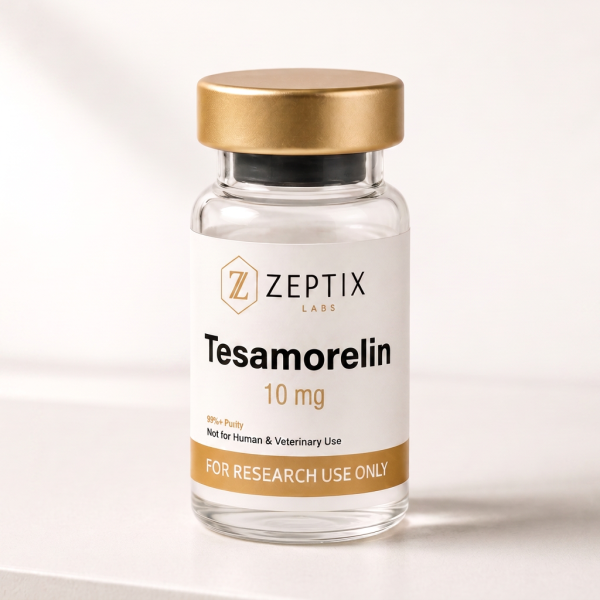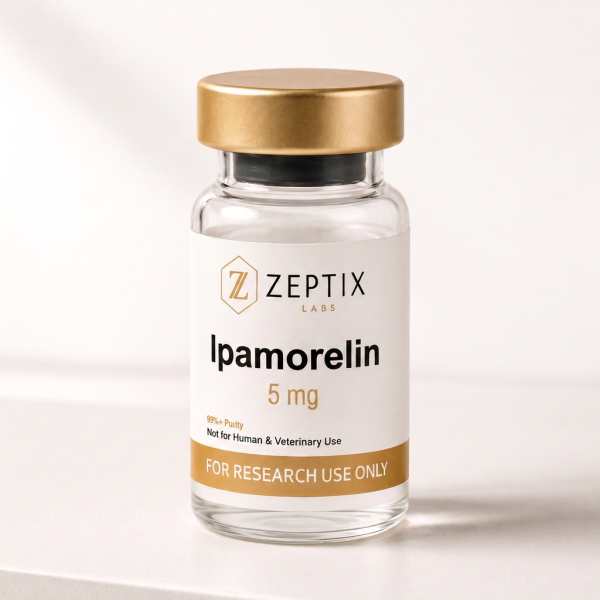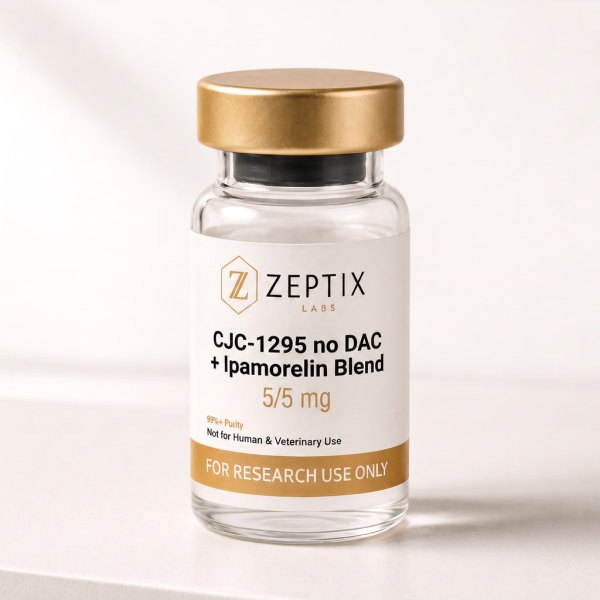

Disclaimer: Information is for research and educational purposes only. Catalog materials are not approved for human or veterinary use.
Tesamorelin and ipamorelin are both studied for one effect: more growth hormone (GH) released from the pituitary's somatotroph cells. They get there by different doors. Tesamorelin activates the growth hormone-releasing hormone receptor (GHRHR). Ipamorelin activates the ghrelin receptor, also called the growth hormone secretagogue receptor (GHS-R1a). That difference shapes how each is used in an experiment.
Side by side
| Tesamorelin | Ipamorelin | |
|---|---|---|
| Class | GHRH analog | Ghrelin receptor agonist (GH secretagogue) |
| Receptor | GHRHR | GHS-R1a |
| Main signaling | Gs, cAMP | Gq, intracellular calcium |
| Length | 44 amino acids | 5 amino acids |
| Structure | Human GHRH(1-44) with an N-terminal trans-3-hexenoyl group | Aib-His-D-2Nal-D-Phe-Lys-NH2 |
| Molar mass | about 5,136 g/mol | 711.9 g/mol |
Tesamorelin: a stabilized GHRH
Tesamorelin keeps the full 44-amino-acid sequence of human GHRH and adds a trans-3-hexenoyl group to the N-terminus. Native GHRH is cut quickly at that end by DPP-4; the modification protects it, so the analog stays active longer while acting on the same receptor.1 A regulated drug version of tesamorelin exists for one specific medical indication, and its clinical studies describe that product only.2
Ipamorelin: a selective ghrelin mimetic
The ghrelin receptor was identified in the pituitary and hypothalamus in 1996, before ghrelin itself was found in 1999.34 Ipamorelin is a synthetic pentapeptide agonist at that receptor. Its first characterization called it the first selective GH secretagogue: in that work it released GH without the clear rises in ACTH and cortisol seen with earlier secretagogues such as GHRP-6 and GHRP-2.5 That selectivity is why it is often the ghrelin-pathway compound of choice when a study wants to keep the stress axis out of the readout.
Why studies pair the two pathways
GHRH and ghrelin signals reach the somatotroph through separate receptors and second messengers, and somatostatin pushes back against both. Studies that combine a GHRH-pathway compound with a ghrelin-pathway compound are asking how the two inputs interact. The CJC-1295 no DAC + Ipamorelin blend in the Zeptix catalog is built around that pairing; CJC-1295 no DAC and Ipamorelin covers it in more detail.
Study design notes
- Match molar amounts. The molar masses differ about sevenfold. One milligram is roughly 0.195 µmol of tesamorelin and 1.405 µmol of ipamorelin.
- Time your sampling. GH release is pulsatile in whole-animal models, so single time points can miss or exaggerate a response. Plan a sampling series.
- Measure GH and IGF-1 separately. They answer different questions on different time scales.
- Use receptor-specific controls. A GHRH receptor antagonist and a ghrelin receptor antagonist or inverse agonist show which pathway produced the effect.
- Mind species differences. Receptor pharmacology is not identical across species; check that the model's receptor responds to the compound.
Tesamorelin and ipamorelin from Zeptix Labs are for laboratory research only. They are not medicines and are not for human or veterinary use.
Frequently asked questions
Is tesamorelin the same as GHRH?
It is an analog of it: the full 44-amino-acid human GHRH sequence with a trans-3-hexenoyl group added at the N-terminus, which protects it from rapid breakdown.
Does ipamorelin act on the GHRH receptor?
No. Ipamorelin acts on the ghrelin receptor (GHS-R1a). Tesamorelin acts on the GHRH receptor.
Why are GHRH analogs and ghrelin mimetics studied together?
They stimulate the same pituitary cells through separate receptors, so combining them shows how the two inputs interact. The CJC-1295 no DAC + Ipamorelin blend is an example of that pairing.
References
- Ferdinandi ES, Brazeau P, High K, Procter B, Fennell S, Dubreuil P. Non-clinical pharmacology and safety evaluation of TH9507, a human growth hormone-releasing factor analogue. Basic Clin Pharmacol Toxicol. 2007;100(1):49-58. https://doi.org/10.1111/j.1742-7843.2007.00008.x
- Falutz J, Allas S, Blot K, et al. Metabolic effects of a growth hormone-releasing factor in patients with HIV. N Engl J Med. 2007;357(23):2359-2370. https://doi.org/10.1056/NEJMoa072375
- Howard AD, Feighner SD, Cully DF, et al. A receptor in pituitary and hypothalamus that functions in growth hormone release. Science. 1996;273(5277):974-977. https://doi.org/10.1126/science.273.5277.974
- Kojima M, Hosoda H, Date Y, Nakazato M, Matsuo H, Kangawa K. Ghrelin is a growth-hormone-releasing acylated peptide from stomach. Nature. 1999;402(6762):656-660. https://doi.org/10.1038/45230
- Raun K, Hansen BS, Johansen NL, et al. Ipamorelin, the first selective growth hormone secretagogue. Eur J Endocrinol. 1998;139(5):552-561. https://doi.org/10.1530/eje.0.1390552