

Disclaimer: Information is for research and educational purposes only. Catalog materials are not approved for human or veterinary use.
KPV is a tripeptide: lysine, proline, valine. Those three amino acids are positions 11 to 13 of alpha-melanocyte-stimulating hormone (alpha-MSH), the C-terminal end of the hormone. At about 342 g/mol it is one of the smallest peptides with a research literature of its own, and it is the component that makes the KLOW blend different from GLOW.
Where it comes from
Alpha-MSH is a 13-amino-acid hormone studied for pigmentation and for anti-inflammatory signaling. Reviews of the melanocortin family describe the whole hormone and several fragments, KPV among them, as a group with anti-inflammatory activity in laboratory models.12
| alpha-MSH | KPV | |
|---|---|---|
| Length | 13 amino acids | 3 amino acids |
| Sequence | Ac-SYSMEHFRWGKPV-NH2 | Lys-Pro-Val (positions 11 to 13) |
| Molar mass | about 1,665 g/mol | about 342 g/mol |
| Receptor activity in cited models | Acts at melanocortin receptors | Reported effects that did not depend on melanocortin receptor signaling |
What the published work measured
In a mouse peritonitis model, KPV reduced leukocyte accumulation, and the effect was not blocked by a melanocortin receptor 3/4 antagonist. In the same study KPV did not raise cAMP or inhibit macrophage cytokine release the way the core melanocortin peptides did, which led the authors to conclude that its anti-inflammatory effect works differently from theirs.3
Two mouse colitis models, dextran sodium sulfate and CD45RB transfer, reported reduced inflammatory infiltrate and myeloperoxidase activity after KPV treatment, including in mice with a non-functional melanocortin-1 receptor.4 Separate work found that intestinal epithelial cells take KPV up through the peptide transporter PepT1, which is part of why the tripeptide appears so often in gut-barrier research.5 Later work packaged it into orally delivered nanoparticles in a colitis model.6
All of that is cell and rodent work. It describes what happened in those models, not an outcome in people, and none of it makes KPV a treatment.
Why a three-amino-acid peptide is interesting to study
- It is cheap and easy to make. Three residues means straightforward synthesis and a simple purity profile on HPLC.
- It is a transporter substrate. PepT1 carries di- and tripeptides, so KPV has a route into epithelial cells that a 13-amino-acid hormone does not.
- It separates one signal from the rest. Comparing KPV with full alpha-MSH asks which part of the hormone's activity in a model needs the receptor and which does not.
KPV in the Zeptix catalog
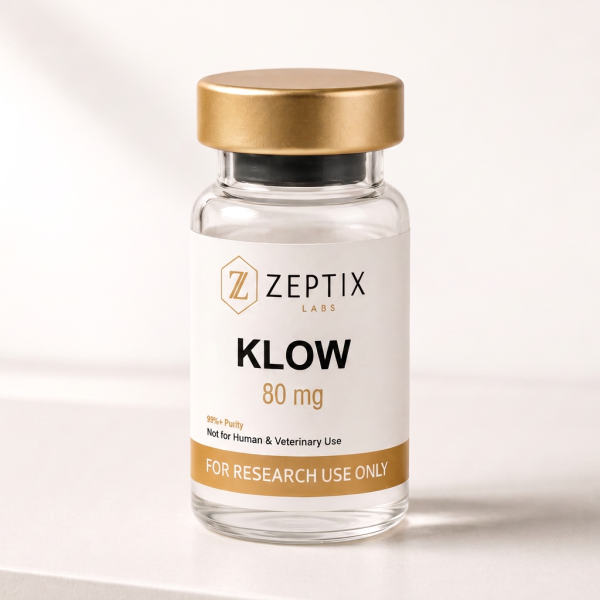
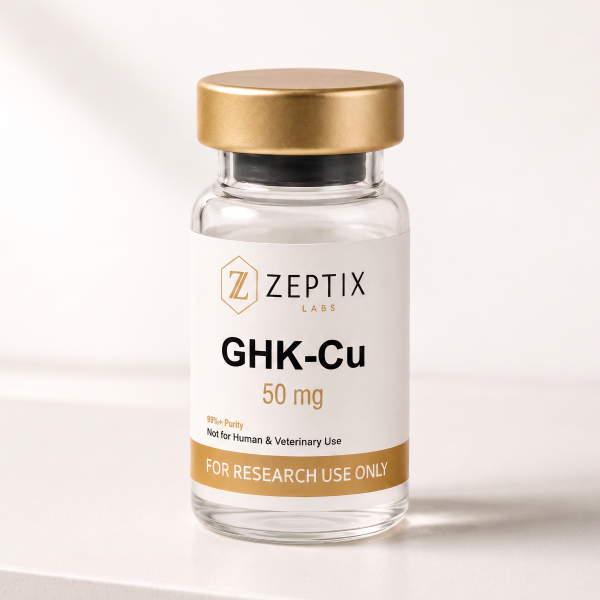
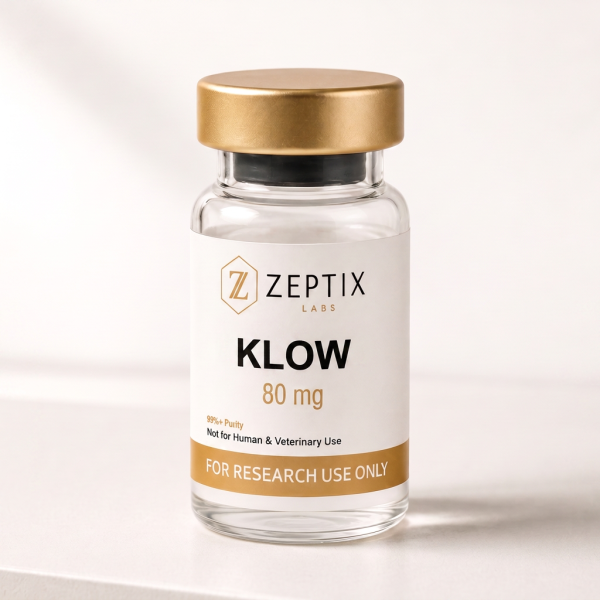
KPV is not sold on its own here. It is one of the four peptides in KLOW, alongside GHK-Cu, BPC-157 and TB-500. GLOW is the same blend without it, which makes the two a natural pair for an experiment: the difference between them is KPV.
Because a blend's composition is defined per lot, work from the certificate of analysis for what a specific vial contains rather than from the product name.
Study design notes
- Use molar amounts. One milligram of KPV is about 2.9 micromoles, far more molecules than a milligram of a larger peptide, so matching masses across compounds compares the wrong thing.
- Include a scrambled control. A peptide with the same three amino acids in another order tests whether the sequence matters.
- Record the counterion. Small synthetic peptides are usually purified as trifluoroacetate salts, and residual trifluoroacetate has its own effects in cell culture.
- Check the model's receptors. The cited work makes a point of effects that persisted without functional melanocortin receptor signaling, so a design that assumes the receptor may miss what is happening.
KPV is supplied here only as a component of the KLOW research blend, for laboratory use by qualified personnel. It is not a drug, supplement or cosmetic, and is not for human or veterinary use.
Frequently asked questions
What does KPV stand for?
It is the one-letter code for the amino acids lysine, proline and valine, the last three residues of alpha-melanocyte-stimulating hormone.
What is KPV studied for?
Mostly inflammation and gut-barrier models in mice and in cultured epithelial cells, where it has been reported to reduce inflammatory markers without depending on melanocortin receptor signaling.
Is KPV the same as alpha-MSH?
No. KPV is a three-amino-acid fragment of the 13-amino-acid hormone. In the cited studies it behaved differently from the full hormone and from the core melanocortin peptides.
Does Zeptix Labs sell KPV on its own?
No. KPV is one of the four peptides in the KLOW research blend. GLOW is the same blend without KPV.
References
- Brzoska T, Luger TA, Maaser C, Abels C, Bohm M. Alpha-melanocyte-stimulating hormone and related tripeptides: biochemistry, antiinflammatory and protective effects in vitro and in vivo, and future perspectives for the treatment of immune-mediated inflammatory diseases. Endocr Rev. 2008;29(5):581-602. https://doi.org/10.1210/er.2007-0027
- Luger TA, Brzoska T. Alpha-MSH related peptides: a new class of anti-inflammatory and immunomodulating drugs. Ann Rheum Dis. 2007;66(Suppl 3):iii52-iii55. https://doi.org/10.1136/ard.2007.079780
- Getting SJ, Schioth HB, Perretti M. Dissection of the anti-inflammatory effect of the core and C-terminal (KPV) alpha-melanocyte-stimulating hormone peptides. J Pharmacol Exp Ther. 2003;306(2):631-637. https://doi.org/10.1124/jpet.103.051623
- Kannengiesser K, Maaser C, Heidemann J, et al. Melanocortin-derived tripeptide KPV has anti-inflammatory potential in murine models of inflammatory bowel disease. Inflamm Bowel Dis. 2008;14(3):324-331. https://doi.org/10.1002/ibd.20334
- Dalmasso G, Charrier-Hisamuddin L, Nguyen HTT, et al. PepT1-mediated tripeptide KPV uptake reduces intestinal inflammation. Gastroenterology. 2008;134(1):166-178. https://doi.org/10.1053/j.gastro.2007.10.026
- Xiao B, Xu Z, Viennois E, et al. Orally targeted delivery of tripeptide KPV via hyaluronic acid-functionalized nanoparticles efficiently alleviates ulcerative colitis. Mol Ther. 2017;25(7):1628-1640. https://doi.org/10.1016/j.ymthe.2016.11.020