
Disclaimer: Information is for research and educational purposes only. Catalog materials are not approved for human or veterinary use.
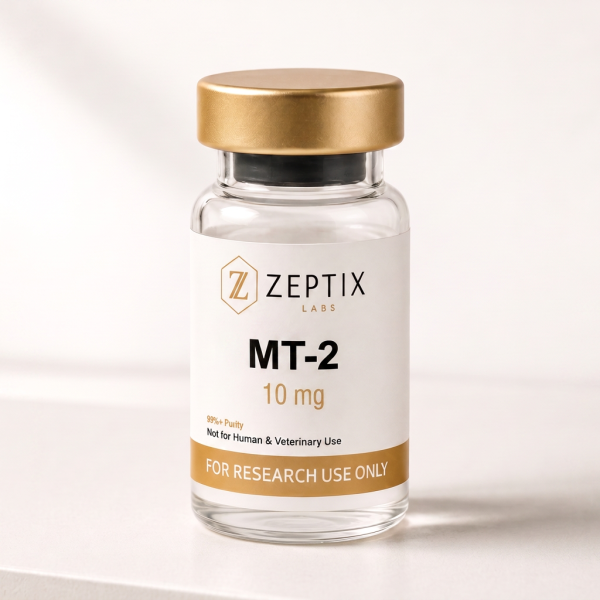
MT-2, also written Melanotan 2 or Melanotan II, is a synthetic cyclic peptide used to study melanocortin receptors. Those receptors sit in pigmentation and energy-balance pathways. The research compound is not a tanning product and Zeptix Labs does not sell it for cosmetic use.
Melanocortin research context
Melanocortin receptors (including MC1R and others in the family) are a standard pharmacology teaching set. MT-2 is one of the ligands laboratories use when they need a research agonist in that family. Receptor selectivity, species of the assay, and buffer conditions all belong in the methods, not in marketing copy.
What it is not
It is not approved as a tanning drug. It is not a substitute for sunscreen research. It is not intended for injection, ingestion, or any human or animal application. The Zeptix listing is a laboratory material with RUO labeling.
MT-2 from Zeptix Labs is for qualified laboratory research only. Not for tanning, cosmetic use, or administration.
Research context and evidence base
Melanotan II is a synthetic cyclic melanocortin ligand used in receptor and pigmentation-pathway research. MC1R, MC3R, MC4R, and MC5R activity can produce different experimental readouts. Receptor subtype, species, comparator ligand, and assay format are therefore essential context, and research findings must not be reframed as tanning instructions.12
How to interpret the published evidence
Evidence should be sorted by study type before it is summarized. Analytical characterization establishes what material was tested; cell work can suggest pathways; animal models can explore integrated biology; and human studies, when they exist, apply only to their regulated product, population, and design. One layer should not be presented as if it proves the next.3
Experimental design questions
Melanocortin experiments should identify the receptor subtype and use a comparator with a known profile in that assay. Pigment production, receptor activation, appetite-related markers, and behavioral readouts represent different biological systems. Light exposure and cell-line pigmentation can also confound melanogenesis work, so those variables belong in the protocol.
Building a reproducible laboratory record
For work involving What Is Melanotan-2, record the supplier, SKU, lot number, labeled amount, receipt date, storage history, reconstitution conditions, concentration calculation, control material, instrument or assay version, and prespecified endpoint. Keep the matching certificate of analysis with the run record. These details make a result auditable and help distinguish biological variation from a handling or identity problem.
- Match the exact compound, sequence, modification, and formulation to the cited methods.
- Use positive, negative, and vehicle controls appropriate to the assay.
- Define concentrations, time points, exclusions, and endpoints before reviewing results.
- Report null and unexpected findings alongside the planned readouts.
Quality, limitations, and research-use status
A certificate of analysis supports lot traceability but does not establish a biological outcome. Investigators remain responsible for method suitability, independent confirmation when required, and compliance with institutional rules. Zeptix Labs materials are supplied for qualified laboratory research only and are not drugs, supplements, cosmetics, foods, or materials for human or veterinary administration.
Reporting results without overreach
When reporting What Is Melanotan-2, state what the experiment directly measured and keep interpretation within that boundary. Include model limitations, uncertainty, failed quality controls, and alternative explanations. Avoid turning preclinical observations into treatment language or assuming that a statistically significant marker change is biologically important. Clear limitations make the article more useful to researchers and prevent laboratory evidence from being mistaken for consumer guidance.
References
- Abdel-Malek Z, et al. “Melanocortin receptors and human pigmentation.” Pigment Cell Res. 2001;14(3):153–160. https://pubmed.ncbi.nlm.nih.gov/11434561/
- Wessells H, et al. “Effect of melanocortin receptor agonist Melanotan-II in men with erectile dysfunction: a randomized controlled trial.” Arch Neurol. 2000;57(4):449–455. https://pubmed.ncbi.nlm.nih.gov/10768691/
- Böhm M, et al. “Melanocortin receptor ligands: new horizons for skin biology and clinical dermatology.” J Invest Dermatol. 2006;126(9):1966–1975. https://pubmed.ncbi.nlm.nih.gov/16912692/
- Kievit P, et al. “Chronic treatment with a melanocortin-4 receptor agonist causes weight loss and improves insulin sensitivity in diet-induced obese monkeys.” J Clin Endocrinol Metab. 2013;98(2):E291–E300. https://pubmed.ncbi.nlm.nih.gov/23275596/
- Dorr RT, Lines R, Levine N, et al. Evaluation of melanotan-II, a superpotent cyclic melanotropic peptide in a pilot phase I clinical study. Life Sci. 1996;58(20):1777-1784. https://pubmed.ncbi.nlm.nih.gov/8637402/ https://pubmed.ncbi.nlm.nih.gov/8637402/?utm_source=chatgpt.com
- Wessells H, Fuciarelli K, Hansen J, et al. Synthetic melanotropic peptide initiates erections in men with psychogenic erectile dysfunction: double-blind, placebo-controlled crossover study. J Urol. 1998;160(2):389-393. https://pubmed.ncbi.nlm.nih.gov/9679884/ https://pubmed.ncbi.nlm.nih.gov/9679884/?utm_source=chatgpt.com
- Vemulapalli R, Kurosawa M, Killinger J, et al. Activation of central melanocortin receptors by melanotan-II (Ac-Nle-c[Asp-His-D-Phe-Arg-Trp-Lys]-NH₂) results in penile erection in rats. Neuroscience. 2001;106(3):547-552. https://pubmed.ncbi.nlm.nih.gov/11591452/
- Wessells H, Hruby V J, Hackett J, et al. Central melanocortin pathways mediate the erectogenic effects of melanotan-II in animal models. J Urol. 2003;170(6 Pt 1):S. (Abstract and mechanistic report.) https://pubmed.ncbi.nlm.nih.gov/14665870/
- Rosen R C, Diamond L E, Earle D C, Shadiack A M, Molinoff P B. Evaluation of the safety, pharmacokinetics and pharmacodynamics of intranasal PT-141, a melanocortin receptor agonist, in healthy males and patients with erectile dysfunction. J Sex Med. 2004;1(3):193-202. https://pubmed.ncbi.nlm.nih.gov/14999221/ https://pubmed.ncbi.nlm.nih.gov/14999221/?utm_source=chatgpt.com
- Diamond L E, Earle D C, Garcia W D, Spana C. Double-blind, placebo-controlled evaluation of the safety, efficacy and dose response of subcutaneous PT-141 in men with erectile dysfunction. Int J Impot Res. 2004;16(4):353-360. https://pubmed.ncbi.nlm.nih.gov/14963471/ https://pubmed.ncbi.nlm.nih.gov/14963471/?utm_source=chatgpt.com