

Disclaimer: Information is for research and educational purposes only. Catalog materials are not approved for human or veterinary use.
The wolverine stack is an internet nickname, not a scientific term. It refers to running two research peptides together: BPC-157 and TB-500. The name borrowed a comic book character known for healing quickly, and it sets an expectation no published study supports. What does exist is a separate literature on each peptide, almost entirely in cells and animals, which is worth reading on its own terms before deciding whether a combined reagent answers a laboratory question.
What the name refers to
| BPC-157 | TB-500 | |
|---|---|---|
| What it is | A synthetic 15-amino-acid peptide (a pentadecapeptide) described from a gastric protein sequence | A market name for synthetic thymosin beta-4, or for its acetylated actin-binding fragment Ac-LKKTETQ |
| Length | 15 amino acids | 43 amino acids full length, or 7 for the fragment |
| Research themes | Tendon, muscle and gastrointestinal models, angiogenic and growth-factor signaling | G-actin binding, cell migration, wound and corneal models |
| Where results come from | Rodent models and cell culture | Rodent models and cell culture |
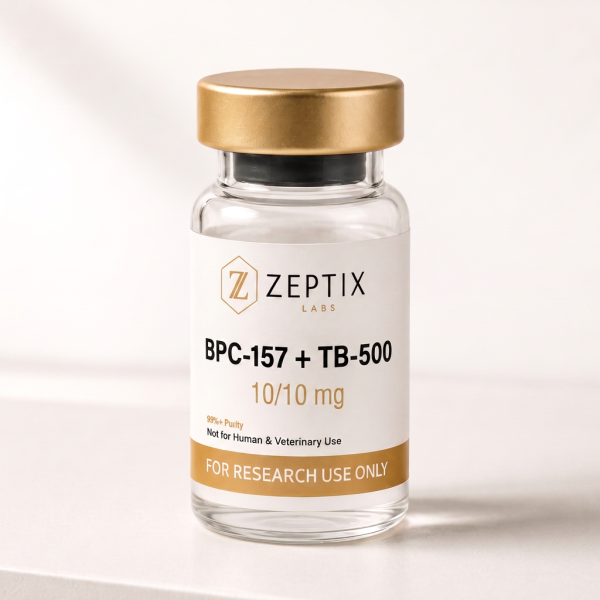
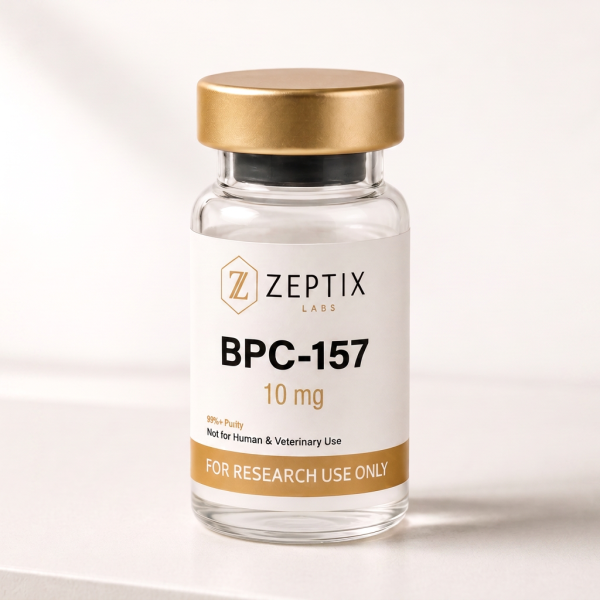
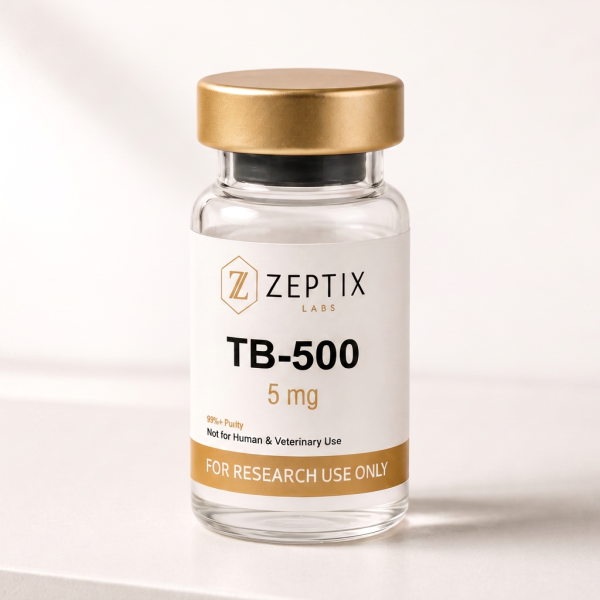
Both are sold as single peptides and as a blend. Zeptix Labs lists BPC-157, TB-500 and a BPC-157 + TB-500 blend separately, so a protocol can use whichever matches its design.
What the BPC-157 research covers
The published work on BPC-157 is mostly in rats. Transected Achilles tendon models reported faster closure measured by histology and tensile testing, and cultured tendon fibroblasts showed increased outgrowth and migration in the same group's work.12 Reviews from the laboratories that produced most of that work describe proposed links to angiogenic growth-factor signaling and nitric oxide pathways.3
Two limits matter when reading it. A large share of the literature comes from a small number of groups, and independent replication outside those groups is limited. And every result sits in an animal or a cell model, so the measured endpoint is the result, not a conclusion about people.
What the TB-500 research covers
Thymosin beta-4 is a 43-amino-acid peptide that binds monomeric G-actin and holds it back from forming filaments, which is why it appears in cell-migration, angiogenesis and wound-model research.4 A synthetic peptide containing only its actin-binding domain was also reported to promote dermal repair in mice, which is part of why the shorter fragment is sold under the same name.5
That is the catch with TB-500 as a label: analytical work on doping control describes TB-500 as a synthetic version of an active region of thymosin beta-4, not the whole peptide.6 A paper on full-length thymosin beta-4 does not automatically describe what is in a vial labeled TB-500. The COA's mass settles it: about 4,963 Da for the full peptide, about 889 Da for the Ac-LKKTETQ fragment.
What the nickname adds, and what it does not
No study in that reference list tested the two peptides together. The pairing comes from forum culture, where the reasoning is that one peptide is associated with tissue-response models and the other with cell migration, so running both should do more. That is a hypothesis, not a finding, and it is the kind of claim a two-arm experiment is built to test.
A combination also changes what a result can tell you. If a blend produces an effect, the blend produced it. Attributing it to one component needs the components run on their own in the same experiment.
Designing a study around the pairing
- Run four arms, not two. Vehicle, BPC-157 alone, TB-500 alone, and both together. Anything less cannot separate an additive effect from one peptide doing the work.
- Fix the molecule, not just the name. Record the sequence and the mass from the COA for the TB-500 lot, since the name covers more than one molecule.
- Work in molar amounts. One milligram of a 15-amino-acid peptide and one milligram of a 43-amino-acid peptide are very different numbers of molecules.
- Match the diluent across arms. Same water, same volume, same handling, so the vehicle is not a hidden variable.
- Prespecify the endpoint. Histology, tensile strength, migration distance and marker levels answer different questions; picking after seeing the data inflates the result.
Ordering notes
A blend vial is convenient when the experiment is about the mixture. Separate vials are better when the experiment is about the components, because the ratio is then yours to set and each lot carries its own certificate of analysis. Keep the lot numbers with the run record either way.
BPC-157 and TB-500 from Zeptix Labs are supplied for laboratory research only. They are not drugs, supplements or cosmetics, and are not for human or veterinary use. The wolverine stack is a nickname used online, not a protocol this site recommends.
Frequently asked questions
What peptides are in the wolverine stack?
The name is used for BPC-157 together with TB-500. Both are research peptides, and the pairing comes from online discussion rather than from a published study of the combination.
Is there research on BPC-157 and TB-500 used together?
The published work is on each peptide separately, mostly in rodents and cell culture. A study of the pair would need arms for each peptide alone and for the combination to say anything about the mixture.
Is the wolverine stack safe?
That question cannot be answered here. These are research materials for laboratory use only, not products for human or veterinary use, so there is no safe use outside a laboratory protocol.
Should a laboratory order the blend or two separate vials?
Order the blend when the experiment is about the mixture. Order separate vials when the experiment needs to compare the peptides or set the ratio, since each lot then carries its own certificate of analysis.
References
- Staresinic M, Sebecic B, Patrlj L, et al. Gastric pentadecapeptide BPC 157 accelerates healing of transected rat Achilles tendon and in vitro stimulates tendocytes growth. J Orthop Res. 2003;21(6):976-983. https://doi.org/10.1016/S0736-0266(03)00110-4
- Chang CH, Tsai WC, Lin MS, Hsu YH, Pang JHS. The promoting effect of pentadecapeptide BPC 157 on tendon healing involves tendon outgrowth, cell survival, and cell migration. J Appl Physiol. 2011;110(3):774-780. https://doi.org/10.1152/japplphysiol.00945.2010
- Seiwerth S, Rucman R, Turkovic B, et al. BPC 157 and standard angiogenic growth factors. Gastrointestinal tract healing, lessons from tendon, ligament, muscle and bone healing. Curr Pharm Des. 2018;24(18):1972-1989. https://doi.org/10.2174/1381612824666180712110447
- Goldstein AL, Hannappel E, Sosne G, Kleinman HK. Thymosin beta-4: a multi-functional regenerative peptide. Basic properties and clinical applications. Expert Opin Biol Ther. 2012;12(1):37-51. https://doi.org/10.1517/14712598.2012.634793
- Philp D, Badamchian M, Scheremeta B, et al. Thymosin beta-4 and a synthetic peptide containing its actin-binding domain promote dermal wound repair in db/db diabetic mice and in aged mice. Wound Repair Regen. 2003;11(1):19-24. https://doi.org/10.1046/j.1524-475X.2003.11105.x
- Ho ENM, Kwok WH, Lau MY, et al. Doping control analysis of TB-500, a synthetic version of an active region of thymosin beta-4, in equine urine and plasma by liquid chromatography-mass spectrometry. J Chromatogr A. 2012;1265:57-69. https://doi.org/10.1016/j.chroma.2012.09.043