

Disclaimer: Information is for research and educational purposes only. Catalog materials are not approved for human or veterinary use.
Most research peptides ship lyophilized. Dry material is more stable than a solution, but it is still sensitive to heat, moisture, and light. Storage is a documentation problem as much as a fridge problem: the lot, the date received, and the conditions should live in the same notebook as the protocol.
Lyophilized vials
Sealed lyophilized vials are commonly kept cool, dry, and away from direct light. Many laboratories refrigerate or freeze long-term stock and return vials to the cold as soon as they are sampled. Avoid repeated temperature cycling when a working aliquot can be split instead.
After reconstitution
Once a peptide is in solution, stability depends on the sequence, the solvent, the concentration, and the time spent at working temperature. Those choices belong to the protocol, not to a storefront. Research-use products are not supplied with consumer “how to take” instructions.
Where bacteriostatic water fits
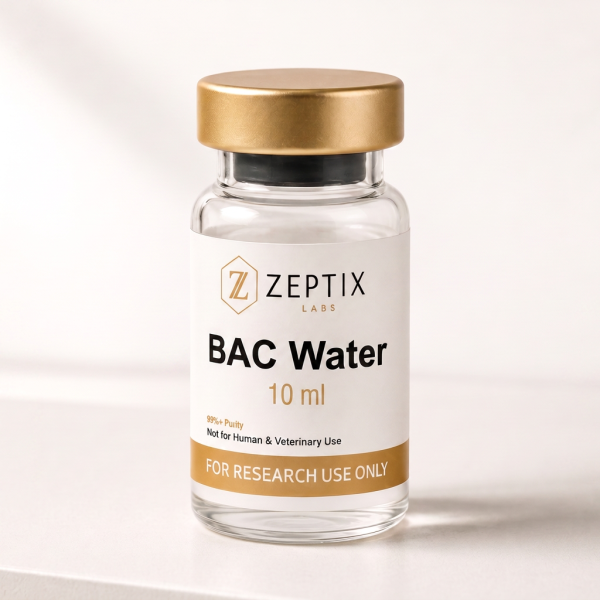
Bacteriostatic water is a laboratory reagent used in some reconstitution workflows. It is not a peptide and it is not a clinical product. See the BAC water article and the product page for RUO sourcing context.
Follow lot paperwork and your institutional SOP. Zeptix Labs materials are for qualified laboratory research only.
Research context and evidence base
Peptide stability is sequence- and formulation-dependent. Temperature is only one variable: moisture, oxygen, light, pH, concentration, adsorption, repeated freeze-thaw cycles, and time in solution can also matter. Storage decisions should follow lot documentation and a validated laboratory procedure rather than a universal rule copied from a different peptide.12
How to interpret the published evidence
Evidence should be sorted by study type before it is summarized. Analytical characterization establishes what material was tested; cell work can suggest pathways; animal models can explore integrated biology; and human studies, when they exist, apply only to their regulated product, population, and design. One layer should not be presented as if it proves the next.3
Experimental design questions
A stability plan should define the material state, container, temperature range, light exposure, humidity protection, sampling intervals, and acceptance criteria. Appearance alone does not establish integrity. Trending chromatography, mass, concentration, or activity over time gives a more defensible storage window than assuming every lyophilized peptide behaves alike.
Building a reproducible laboratory record
For work involving Peptide Storage for Laboratory Research, record the supplier, SKU, lot number, labeled amount, receipt date, storage history, reconstitution conditions, concentration calculation, control material, instrument or assay version, and prespecified endpoint. Keep the matching certificate of analysis with the run record. These details make a result auditable and help distinguish biological variation from a handling or identity problem.
- Match the exact compound, sequence, modification, and formulation to the cited methods.
- Use positive, negative, and vehicle controls appropriate to the assay.
- Define concentrations, time points, exclusions, and endpoints before reviewing results.
- Report null and unexpected findings alongside the planned readouts.
Quality, limitations, and research-use status
A certificate of analysis supports lot traceability but does not establish a biological outcome. Investigators remain responsible for method suitability, independent confirmation when required, and compliance with institutional rules. Zeptix Labs materials are supplied for qualified laboratory research only and are not drugs, supplements, cosmetics, foods, or materials for human or veterinary administration.
Reporting results without overreach
When reporting Peptide Storage for Laboratory Research, state what the experiment directly measured and keep interpretation within that boundary. Include model limitations, uncertainty, failed quality controls, and alternative explanations. Avoid turning preclinical observations into treatment language or assuming that a statistically significant marker change is biologically important. Clear limitations make the article more useful to researchers and prevent laboratory evidence from being mistaken for consumer guidance.
References
- Manning, M. C., et al. “Stability of Protein Pharmaceuticals: An Update.” Pharmaceutical Research 27 (2010): 544–575. https://pubmed.ncbi.nlm.nih.gov/20143256/
- Wang, W. “Instability, Stabilization, and Formulation of Liquid Protein Pharmaceuticals.” International Journal of Pharmaceutics 185, no. 2 (1999): 129–188. https://pubmed.ncbi.nlm.nih.gov/10460913/
- Bak, A., et al. “Physicochemical and Formulation Developability Assessment for Therapeutic Peptide Delivery.” AAPS Journal 17 (2015): 144–155. https://pubmed.ncbi.nlm.nih.gov/?term=Bak+physicochemical+formulation+developability+therapeutic+peptide+delivery