

Disclaimer: Information is for research and educational purposes only. Catalog materials are not approved for human or veterinary use.
Bacteriostatic water and sterile water look identical in the vial and differ by one ingredient. Bacteriostatic water contains an antimicrobial preservative, almost always benzyl alcohol at 0.9%. Sterile water contains nothing but water. That single difference decides how many times a vial can be entered, and it adds a compound to every solution made with it.
The difference in one table
| Bacteriostatic water | Sterile water | |
|---|---|---|
| Contents | Water plus about 0.9% benzyl alcohol | Water only |
| What the preservative does | Limits growth of bacteria that enter when the stopper is punctured | Nothing; there is no preservative |
| Typical use | A stock vial sampled several times over days | Single use, or a solution aliquoted and frozen straight away |
| Extra variable in an assay | Benzyl alcohol, which is not inert | None beyond the water |
| Vehicle control needed | Yes, matched diluent with no peptide | Yes, matched diluent with no peptide |
Why the preservative exists
Preservatives are added to multiple-dose containers so that organisms introduced when the closure is punctured do not multiply between withdrawals. Reviews of preservative use in parenteral products describe benzyl alcohol as one of the most common choices, and note that its concentration is a formulation decision rather than an incidental detail.1
Bacteriostatic means it holds growth back. It does not sterilize a contaminated solution, and it does nothing about chemical degradation of the peptide itself.
Benzyl alcohol is not an inert spectator
In formulation research, benzyl alcohol accelerated aggregation of recombinant human interleukin-1 receptor antagonist in solution. The mechanism described was binding to the protein and shifting the population toward partially unfolded, aggregation-prone forms, rather than a change in secondary structure.2 A companion study found the same effect in reconstituted lyophilized formulations, where the solid-state history of the material changed how much aggregation followed.3
Those studies used a protein, not a short peptide, and small peptides have less structure to lose. The point is not that benzyl alcohol ruins peptides; it is that a preservative is a real excipient with documented interactions, and reviews of excipient and drug interactions in parenteral formulations treat it as one.4
Choosing between them
- Several withdrawals over days: bacteriostatic water, so a punctured stopper is less of a risk between samples.
- One use, or aliquot and freeze: sterile water, which keeps the preservative out of the system entirely.
- Cell culture at low volumes: weigh the final benzyl alcohol concentration after dilution, and run a vehicle control made from the same water.
- A peptide prone to aggregation: consider sterile water with single-use aliquots, since the preservative is one more thing nudging the equilibrium.
- Analytical work: match the diluent to the method; a preservative peak can land in the middle of a chromatogram.
Working out what reaches the assay
The preservative travels with the solution. If a stock is made in bacteriostatic water at 0.9% benzyl alcohol and then diluted 1 in 100 into medium, the medium carries about 0.009% benzyl alcohol, roughly 0.8 millimolar. Whether that matters depends on the system, which is what the vehicle control is for: the same dilution of the same water, without peptide.
Handling either one
- Wipe the stopper with 70% isopropyl alcohol and let it dry before every entry.
- Add the diluent down the vial wall, then swirl. Do not shake.
- Label the vial with the diluent, the volume, the concentration, the date and the lot.
- Record how many times a multi-use vial has been entered.
- Keep the reconstituted solution cold and out of the light, and follow the product's storage card.
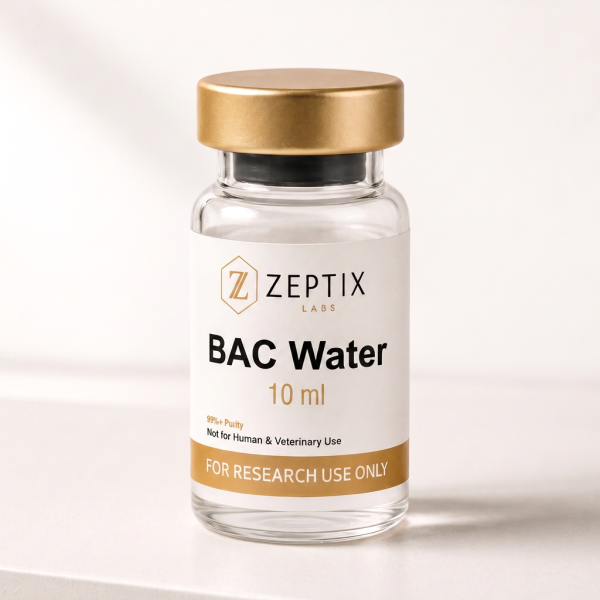
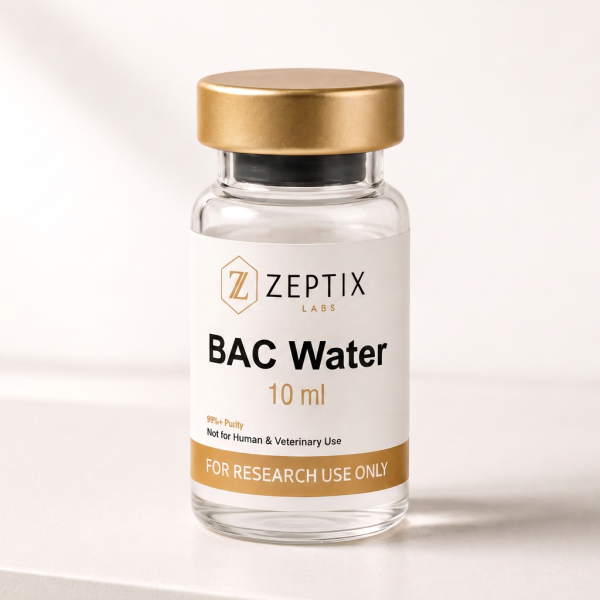
Bacteriostatic water from Zeptix Labs is a laboratory reagent for qualified research use. It is not a clinical product, and neither it nor the peptides it is used with are for human or veterinary use. Labeling records for commercial bacteriostatic water products are published by the National Library of Medicine.5
Frequently asked questions
What is the difference between bacteriostatic water and sterile water?
Bacteriostatic water contains about 0.9% benzyl alcohol as a preservative, which limits bacterial growth after the stopper is punctured. Sterile water contains no preservative, so it suits single use or solutions that are aliquoted and frozen straight away.
Can sterile water be used instead of bacteriostatic water?
In a laboratory protocol, yes, provided the vial is treated as single use or the solution is aliquoted and frozen. Without a preservative, every entry into the vial is a contamination risk.
Does benzyl alcohol affect peptides?
It can affect proteins in solution; published work describes benzyl alcohol accelerating aggregation of a recombinant protein by favouring partially unfolded forms. Whether it matters for a given peptide and assay is a question for a vehicle control.
How long can a bacteriostatic water vial be used?
That is a question for the product label and the laboratory's own procedure. The preservative limits microbial growth between withdrawals; it does not stop the peptide in a reconstituted solution from degrading over time.
References
- Meyer BK, Ni A, Hu B, Shi L. Antimicrobial preservative use in parenteral products: past and present. J Pharm Sci. 2007;96(12):3155-3167. https://doi.org/10.1002/jps.20976
- Zhang Y, Roy S, Jones LS, et al. Mechanism for benzyl alcohol-induced aggregation of recombinant human interleukin-1 receptor antagonist in aqueous solution. J Pharm Sci. 2004;93(12):3076-3089. https://doi.org/10.1002/jps.20219
- Roy S, Jung R, Kerwin BA, Randolph TW, Carpenter JF. Effects of benzyl alcohol on aggregation of recombinant human interleukin-1-receptor antagonist in reconstituted lyophilized formulations. J Pharm Sci. 2005;94(2):382-396. https://doi.org/10.1002/jps.20258
- Akers MJ. Excipient-drug interactions in parenteral formulations. J Pharm Sci. 2002;91(11):2283-2300. https://doi.org/10.1002/jps.10154
- U.S. National Library of Medicine. Bacteriostatic Water for Injection labeling records. DailyMed. https://dailymed.nlm.nih.gov/dailymed/search.cfm?query=bacteriostatic%20water