
Disclaimer: Information is for research and educational purposes only. Catalog materials are not approved for human or veterinary use.
Research peptides usually arrive lyophilized: freeze-dried into a powder or a small solid cake at the bottom of the vial. In that state they are far more stable than in solution. Reconstitution means dissolving that powder in a measured volume of liquid to make a solution of known concentration. Every downstream number depends on getting it right, so it is worth doing the same careful way every time.
Before you start
- Read the label and the COA. Note the labeled amount, the lot number and any solubility notes. The certificate of analysis also tells you the purity of that lot.
- Let the vial reach room temperature before opening it. A cold vial pulls moisture from the air onto the powder, and water is the main driver of peptide degradation.1
- Collect the powder. Tap the vial gently, or spin it briefly, so nothing is stuck to the stopper or the walls.
- Work clean. Use a clean bench or biosafety cabinet, sterile materials and a calibrated pipette or sterile transfer device.
Choosing a diluent
| Diluent | Typical use | Watch for |
|---|---|---|
| Bacteriostatic water | A vial that will be sampled several times over days | The 0.9% benzyl alcohol preservative can affect sensitive cell cultures; include a matching vehicle control |
| Sterile water | Single use, or a solution that is aliquoted and frozen straight away | No preservative, so every opening is a contamination risk |
| Dilute acetic acid | Basic or hydrophobic peptides that will not dissolve in water | Lower pH; confirm the assay tolerates it after dilution |
| Assay buffer or saline | Making a working solution from a stock | Salts can lower solubility; dissolve in water first, then dilute |
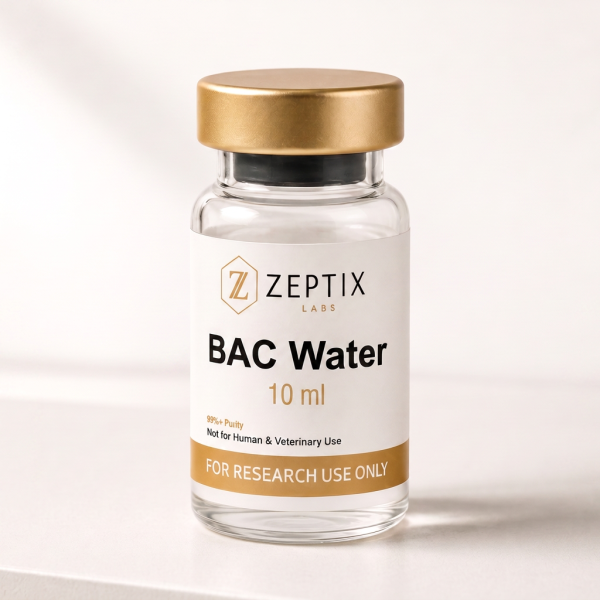
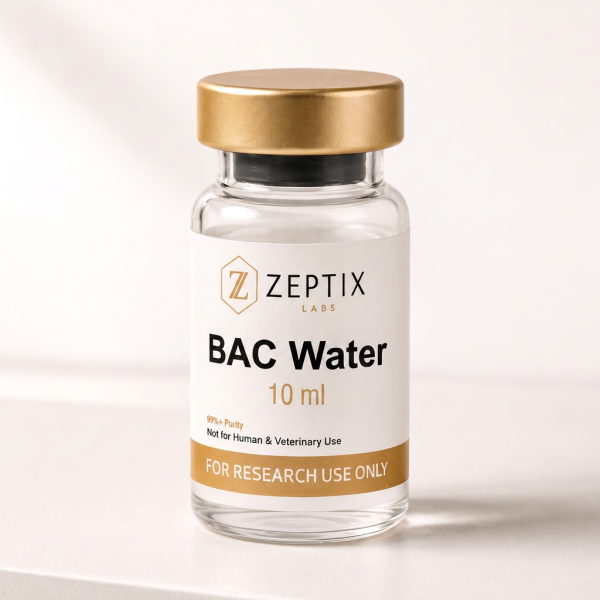
Bacteriostatic water is the most common choice for a stock that will be drawn from more than once. See What Is Bacteriostatic Water? for more on it.
Step by step
- Wipe the vial's rubber stopper with 70% isopropyl alcohol and let it dry.
- Measure the planned volume of diluent.
- Add it slowly, running it down the inside wall of the vial rather than straight onto the powder.
- Swirl gently or roll the vial between your fingers. Do not shake or vortex hard: foaming and air-liquid contact can make peptides unfold and aggregate.23
- Let it stand for a few minutes until the solution is clear.
- Check it against a light and a dark background. It should be clear with no particles. A cloudy solution is not reliable for quantitative work.
- Label the vial with the peptide, concentration, diluent, date and lot number.
Working out the concentration
Concentration is the peptide mass divided by the volume of diluent. A 10 mg vial dissolved in 2.0 mL gives 5 mg/mL; the same vial in 1.0 mL gives 10 mg/mL. To take 250 µg from the 5 mg/mL solution, divide 250 µg by 5 mg/mL (5 µg/µL): 50 µL. Choose a volume that makes the amounts you need easy to pipette accurately. The peptide calculator does this arithmetic for each product.
Two numbers on a COA are easy to mix up. HPLC purity is the share of the peptide material that is the target sequence. Net peptide content is the share of the powder's total mass that is peptide at all, since lyophilized material also holds counterions and some water. For work that depends on exact molar amounts, take both into account.
Storing the solution
- Keep reconstituted peptide refrigerated at 2 to 8 °C and away from light. Each Zeptix product page lists storage times; BPC-157's, for example, lists 30 days at 2 to 8 °C once reconstituted.
- For longer storage, split the stock into single-use aliquots and freeze them. Repeated freezing and thawing damages peptides.2
- A preservative stops microbes from growing. It does not stop the peptide itself from slowly degrading.
Common mistakes
- Shaking the vial to speed things up.
- Opening a vial straight from the freezer.
- Getting the diluent volume wrong, then calculating from the planned volume instead of the real one.
- Using bacteriostatic water in a sensitive cell assay without a vehicle control.
- Not writing down the lot number, diluent and date.
This guide describes laboratory handling of research materials. Zeptix Labs peptides and bacteriostatic water are for laboratory research only and are not for human or veterinary use.
Frequently asked questions
Should I use bacteriostatic water or sterile water?
Bacteriostatic water suits a stock vial that will be sampled several times, because its preservative limits microbial growth. Sterile water suits single use or a solution that is aliquoted and frozen straight away.
Can I shake the vial to dissolve the peptide?
No. Swirl or roll it gently. Shaking causes foaming, and air-liquid contact can make peptides aggregate.
How long does a reconstituted peptide last?
It depends on the peptide and the diluent. Refrigerate at 2 to 8 °C, protect from light, follow the product's storage card, and freeze single-use aliquots for longer storage.
References
- Wang W. Lyophilization and development of solid protein pharmaceuticals. Int J Pharm. 2000;203(1-2):1-60. https://doi.org/10.1016/S0378-5173(00)00423-3
- Manning MC, Chou DK, Murphy BM, Payne RW, Katayama DS. Stability of protein pharmaceuticals: an update. Pharm Res. 2010;27(4):544-575. https://doi.org/10.1007/s11095-009-0045-6
- Frokjaer S, Otzen DE. Protein drug stability: a formulation challenge. Nat Rev Drug Discov. 2005;4(4):298-306. https://doi.org/10.1038/nrd1695