

Disclaimer: Information is for research and educational purposes only. Catalog materials are not approved for human or veterinary use.
The honest answer is that it depends on the sequence, the state the material is in and how it has been kept. A sealed lyophilized vial in a freezer and the same peptide in solution on a bench are two different stability problems. What follows is the chemistry behind the difference, and how a laboratory settles the question for its own lot rather than borrowing a number from a forum.
Dry, cold and refrigerated are not the same question
| State | What limits it | What a laboratory usually does |
|---|---|---|
| Sealed lyophilized powder, frozen | Residual moisture, oxygen, repeated warming | Long-term stock, kept cold, warmed to room temperature before opening |
| Sealed lyophilized powder, refrigerated | The same, with faster solid-state chemistry at higher temperature | Working stock for the near term |
| Solution, refrigerated | Hydrolysis, deamidation, oxidation, aggregation, microbial growth | The product's stated storage window, protected from light |
| Solution, frozen in aliquots | Freeze-thaw stress, surface adsorption, container effects | Single-use aliquots so nothing is thawed twice |
| Solution at room temperature | Everything above, faster | Minutes to hours of working time, not storage |
What actually degrades
Reviews of peptide and protein stability describe the routes in two groups. Chemical degradation covers deamidation of asparagine and glutamine, oxidation of methionine, cysteine and tryptophan, hydrolysis of the backbone, disulfide shuffling and beta-elimination. Physical degradation covers unfolding, surface adsorption and aggregation, which does not change the covalent structure but removes material from solution.12
Deamidation is the clearest example of sequence dependence. A study that measured deamidation rates for 306 asparagine-containing model sequences found that the neighbouring residues changed the rate by orders of magnitude, which is why no single expiry number can cover every peptide.3 An asparagine-glycine pair is fast; the same asparagine in another context is slow.
Why the dry state helps so much
Most of these reactions need water, or at least mobility. Lyophilization removes most of the water and locks the molecules in an amorphous solid, which slows chemistry dramatically. It does not stop it: work on solid-state stability shows that residual moisture, the glass transition temperature of the matrix and storage temperature all still drive degradation in dry powders.45
That is also why a cold vial should be warmed to room temperature before opening. Cold glass condenses moisture from the air straight onto the powder, which is the one thing lyophilization was done to avoid.
After reconstitution
In solution the clock speeds up and aggregation joins the list. Work on peptide aggregation describes concentration, temperature, pH, ionic strength, agitation and air-liquid interfaces as the main physical drivers, which is why shaking a vial is worse than swirling it.6
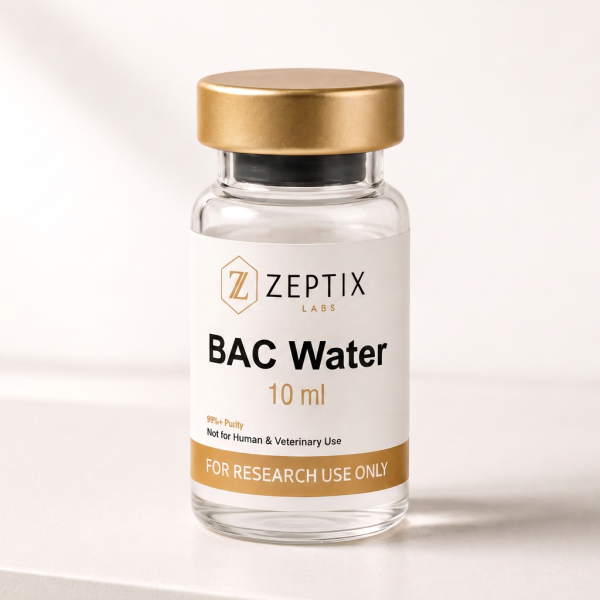
Each Zeptix product page lists a storage window for the reconstituted material. Treat it as the manufacturer's figure for that peptide under those conditions, not as a general rule for every vial on the shelf. A preservative such as the benzyl alcohol in bacteriostatic water limits microbial growth; it does nothing about the chemical routes above.
Testing it rather than guessing
- Pull a time zero sample. Run the stock on HPLC the day it is made, so later runs have a baseline to compare with.
- Sample on a schedule. The same method at set intervals shows the main peak falling and the impurity peaks rising.
- Watch the mass, not just the area. Mass spectrometry separates deamidation and oxidation from simple loss of material.
- Spin before reading. Aggregates that drop out of solution look like degradation on a concentration assay and like nothing on a chromatogram.
- Keep the conditions in the record. Temperature, light, container, concentration and number of freeze-thaw cycles belong with the result.
Appearance proves very little. A clear solution can have lost a third of its target peptide, and a cloudy one is already unusable for quantitative work.
This describes laboratory handling of research materials. Zeptix Labs peptides and bacteriostatic water are supplied for qualified laboratory research only and are not for human or veterinary use.
Frequently asked questions
How long do peptides last in the fridge?
In solution, refrigerated storage is measured in days to weeks and depends on the sequence, the diluent and the concentration. Follow the storage window on the product page for that peptide and, where it matters, confirm it with a chromatographic check of your own lot.
How long does lyophilized peptide last?
Sealed dry powder kept cold and dry is far more stable than a solution, which is why it is shipped that way. The limits are residual moisture, oxygen and repeated warming rather than a fixed date.
Does freezing a reconstituted peptide help?
Freezing single-use aliquots is the usual approach for longer storage. Repeated freezing and thawing is the problem, since each cycle adds concentration and interface stress that can drive aggregation.
How can a laboratory tell whether a peptide has degraded?
By measuring it. A chromatographic run against a time zero sample shows the main peak falling and new peaks appearing, and mass spectrometry distinguishes deamidation or oxidation from loss of material to aggregation.
References
- Manning MC, Chou DK, Murphy BM, Payne RW, Katayama DS. Stability of protein pharmaceuticals: an update. Pharm Res. 2010;27(4):544-575. https://doi.org/10.1007/s11095-009-0045-6
- Wang W. Instability, stabilization, and formulation of liquid protein pharmaceuticals. Int J Pharm. 1999;185(2):129-188. https://doi.org/10.1016/S0378-5173(99)00152-0
- Robinson NE, Robinson AB. Molecular clocks. Proc Natl Acad Sci U S A. 2001;98(3):944-949. https://doi.org/10.1073/pnas.98.3.944
- Wang W. Lyophilization and development of solid protein pharmaceuticals. Int J Pharm. 2000;203(1-2):1-60. https://doi.org/10.1016/S0378-5173(00)00423-3
- Lai MC, Topp EM. Solid-state chemical stability of proteins and peptides. J Pharm Sci. 1999;88(5):489-500. https://doi.org/10.1021/js980374e
- Zapadka KL, Becher FJ, Gomes dos Santos AL, Jackson SE. Factors affecting the physical stability (aggregation) of peptide therapeutics. Interface Focus. 2017;7(6):20170030. https://doi.org/10.1098/rsfs.2017.0030