

Disclaimer: Information is for research and educational purposes only. Catalog materials are not approved for human or veterinary use.
Peptide purity is usually quoted as a single percentage, and it is usually quoted without the method that produced it. That number is useful, but it answers a narrower question than most people assume: of the peptide-like material the detector saw, how much was one peak. It does not say what the peak is, how much of the powder is peptide at all, or what else is in the vial.
What the percentage actually measures
Chromatographic purity is an area percent. The sample is separated by reversed-phase HPLC, the detector records a trace, and the main peak's area is divided by the total area of all integrated peaks. 99% means the main peak accounted for 99% of that area under those conditions.1
Three things follow from the definition. Only what elutes and absorbs is counted, so salts, water and anything invisible at the detection wavelength are outside the sum. Detection is usually at about 214 nm, where the amide bond absorbs, which makes the trace roughly proportional to peptide bonds rather than to any one compound. And the conditions matter: a different gradient or column can merge two peaks into one and raise the number without changing the material.
Purity, identity and content are three different fields
| Field | The question it answers | How it is measured |
|---|---|---|
| Identity | Is this the sequence on the label? | Mass spectrometry, compared with the calculated mass; sequencing where needed |
| Chromatographic purity | How much of the eluting material is one peak? | RP-HPLC area percent, with the method and wavelength stated |
| Net peptide content | How much of the powder's mass is peptide? | Amino acid analysis, nitrogen determination or a similar quantitative method |
| Counterion | Which salt is the peptide in? | Ion chromatography or an equivalent assay for trifluoroacetate, acetate or chloride |
| Water content | How much water came with it? | Karl Fischer titration or loss on drying |
A vial can be 99% pure by HPLC and still be well under 99% peptide by mass, because lyophilized material also carries counterions and water. For work that depends on exact molar amounts, net peptide content is the number that belongs in the calculation.
What the impurities are
Reviews of peptide impurity profiles group them into related substances from synthesis, such as deletion and truncation sequences, incompletely deprotected peptides, diastereomers from racemization and oxidized or deamidated forms, and process residues from reagents, solvents and purification.23
The sequence-related ones are the problem for an assay. A deletion peptide differs from the target by one residue, it can elute close to the main peak, and it may bind the same target. That is why identity and purity are separate questions, and why orthogonal methods exist.
Why the counterion is on the list
Reversed-phase purification normally uses trifluoroacetic acid, so synthetic peptides usually arrive as trifluoroacetate salts. Work on osteoblast and chondrocyte cultures found that trifluoroacetate itself reduced cell numbers and thymidine incorporation, and that the same peptide as its trifluoroacetate and hydrochloride salts gave different results.4 If an assay is sensitive at micromolar concentrations, the salt form is part of the experiment.
What poor characterization does to a literature
The obestatin case is the usual example. When several groups could not reproduce the original binding and activation findings, peptides from five manufacturers were profiled: one product turned out to be a different peptide altogether, and two thirds of the rest were below the quality the published experiments needed.5 The conclusion was not about one compound; it was that quality control belongs before the experiment, not after a result fails to replicate.
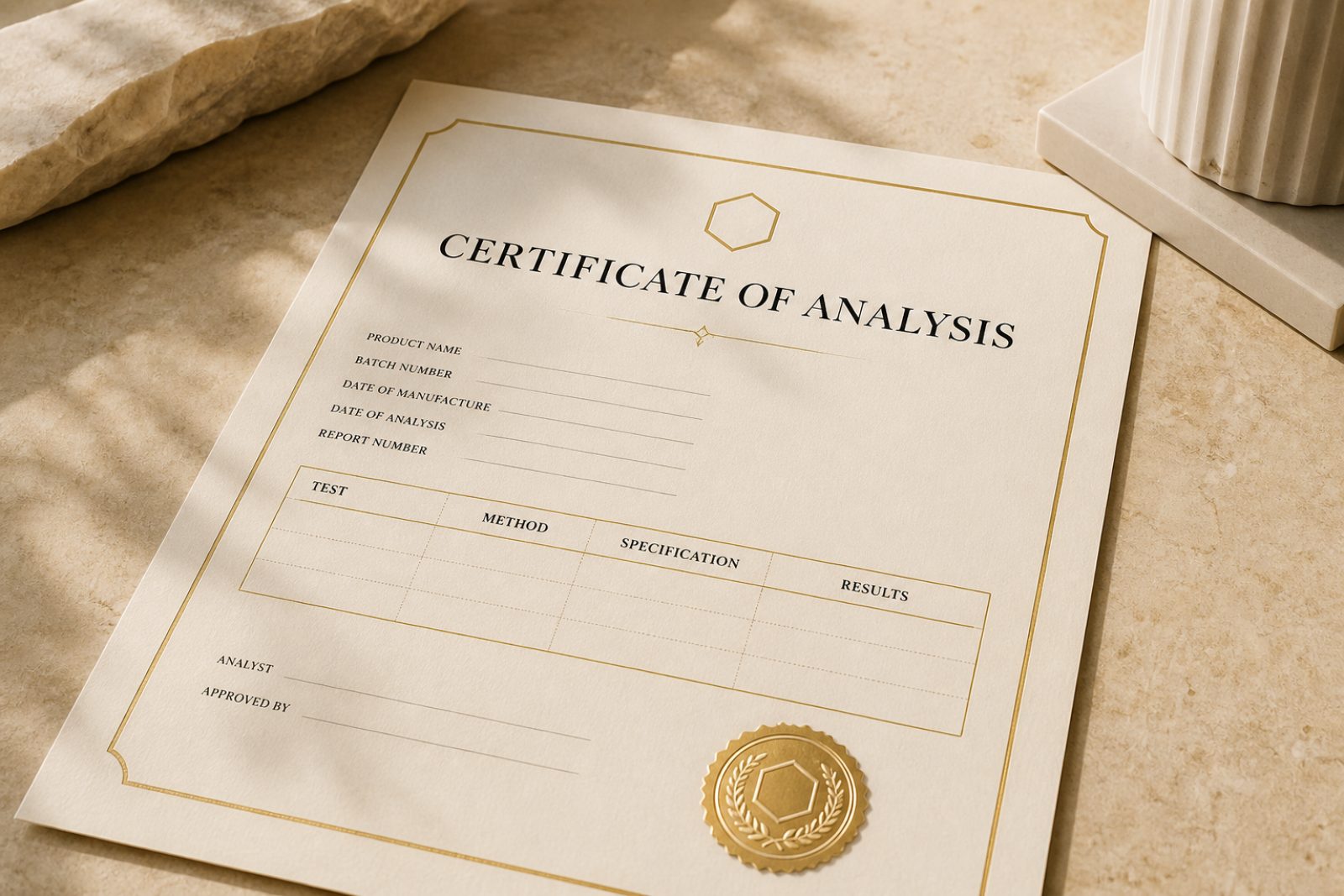
Reading a COA with this in mind
- Check identity first. A purity figure for the wrong molecule is worse than no figure.
- Read the method line. Technique, column, gradient and detection wavelength decide what the percentage means.
- Look for net peptide content. Use it, not the labeled vial mass, when molarity matters.
- Note the counterion and water. Both take up mass, and the counterion can have effects of its own in culture.
- Match the lot. The document describes one lot. Keep the PDF with the experiment that used it.
- Ask what the specification is. A result means little without the acceptance criterion it was compared against.6
Zeptix Labs publishes the certificate for each lot in the COA library, and the companion article on reading a COA walks through the document field by field.
A certificate of analysis supports lot traceability and method transparency. It does not establish a biological outcome, and it is not a license for human or veterinary use. Zeptix Labs materials are supplied for qualified laboratory research only.
Frequently asked questions
What does 99% peptide purity mean?
It means the main peak accounted for about 99% of the integrated peak area in a chromatographic run, under the method stated on the certificate. It is not a statement about how much of the powder is peptide by mass.
What is the difference between HPLC purity and net peptide content?
HPLC purity is the share of the eluting peptide material that is the target peak. Net peptide content is the share of the powder's total mass that is peptide at all, with counterions and water making up the rest.
Why does the counterion matter?
Synthetic peptides are usually trifluoroacetate salts from reversed-phase purification, and residual trifluoroacetate has been reported to affect cell proliferation on its own, which can be mistaken for an effect of the peptide.
Is a higher purity number always better?
Not by itself. A number without the method, the identity confirmation and the lot it belongs to cannot be compared with another supplier's number.
References
- Mant CT, Chen Y, Yan Z, et al. HPLC analysis and purification of peptides. Methods Mol Biol. 2007;386:3-55. https://doi.org/10.1007/978-1-59745-430-8_1
- D'Hondt M, Bracke N, Taevernier L, et al. Related impurities in peptide medicines. J Pharm Biomed Anal. 2014;101:2-30. https://doi.org/10.1016/j.jpba.2014.06.012
- Vergote V, Burvenich C, Van de Wiele C, De Spiegeleer B. Quality specifications for peptide drugs: a regulatory-pharmaceutical approach. J Pept Sci. 2009;15(11):697-710. https://doi.org/10.1002/psc.1167
- Cornish J, Callon KE, Lin CQX, et al. Trifluoroacetate, a contaminant in purified proteins, inhibits proliferation of osteoblasts and chondrocytes. Am J Physiol Endocrinol Metab. 1999;277(5):E779-E783. https://doi.org/10.1152/ajpendo.1999.277.5.E779
- De Spiegeleer B, Vergote V, Pezeshki A, Peremans K, Burvenich C. Impurity profiling quality control testing of synthetic peptides using liquid chromatography-photodiode array-fluorescence and liquid chromatography-electrospray ionization-mass spectrometry: the obestatin case. Anal Biochem. 2008;376(2):229-234. https://doi.org/10.1016/j.ab.2008.02.014
- International Council for Harmonisation. Validation of Analytical Procedures Q2(R2). ICH Harmonised Guideline, 2023. https://database.ich.org/sites/default/files/ICH_Q2%28R2%29_Guideline_2023_1130.pdf